The bob of a pendulum of length l is pulled aside from its equilibrium position through an angle  and then released. The bob will then pass through its equilibrium position with a speed v, where v equals
A

B

C

D

Text Solution
Verified by ExpertsThe correct answer is:
C
If suppose bob rises up to a height h as shown then after releasing potential energy at extreme position becomes kinetic energy of mean position
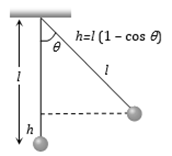


Also, from figure 

So, 
Prepare Smarter with CGP Edu
Get practice questions, solutions, and test series in one place.
Write a Review
Share your experience with this question and solution.
Commentary
Send your comment, doubt, correction, or feedback to admin.
Similar Questions
Explore conceptually related problems
The period of a simple pendulum is doubled, when
The period of oscillation of a simple pendulum of constant length at earth surface is T. Its period…
A simple pendulum is made of a body which is a hollow sphere containing mercury suspended by means …
A pendulum suspended from the ceiling of a train has a period T, when the train is at rest. When th…
The mass and diameter of a planet are twice those of earth. The period of oscillation of pendulum o…
A simple pendulum is set up in a trolley which moves to the right with an acceleration a on a horiz…