Two sources of sound A and B produces the wave of 350 Hz, they vibrate in the same phase. The particle P is vibrating under the influence of these two waves, if the amplitudes at the point P produced by the two waves is 0.3 mm and 0.4 mm, then the resultant amplitude of the point P will be when AP – BP = 25 cm and the velocity of sound is 350 m/sec
Text Solution
Verified by ExpertsThe correct answer is:
D

Also path difference  between the waves at the point of observation is
  . Hence
⇒ ⇒ 
⇒ ⇒ 

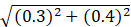 = 0.5
= 0.5 
Prepare Smarter with CGP Edu
Get practice questions, solutions, and test series in one place.
Write a Review
Share your experience with this question and solution.
Commentary
Send your comment, doubt, correction, or feedback to admin.
Similar Questions
Explore conceptually related problems
There is a destructive interference between the two waves of wavelength λ λ coming from two differe…
When two sound waves with a phase difference of , and each having amplitude A and frequency , are…
If the phase difference between the two wave is 2 π π during superposition, then the resultant ampl…
The superposition takes place between two waves of frequency f and amplitude a. The total intensity…
If two waves of same frequency and same amplitude respectively, on superimposition produced a resul…
Two waves are propagating to the point P along a straight line produced by two sources A and B of s…