Two adjacent piano keys are struck simultaneously. The notes emitted by them have frequencies  and
and  . The number of beats heard per second is
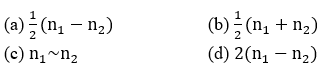
Text Solution
Verified by ExpertsThe correct answer is:
C
No detailed text explanation provided yet.
Prepare Smarter with CGP Edu
Get practice questions, solutions, and test series in one place.
Write a Review
Share your experience with this question and solution.
Commentary
Send your comment, doubt, correction, or feedback to admin.
Similar Questions
Explore conceptually related problems
Two tuning forks when sounded together produced 4 beats/sec. The frequency of one fork is 256. The …
Beats are the result of
A tuning fork of frequency 100 when sounded together with another tuning fork of unknown frequency …
A tuning fork sounded together with a tuning fork of frequency 256 emits two beats. On loading the …
If two tuning forks A and B are sounded together, they produce 4 beats per second. A is then slight…
The frequencies of two sound sources are 256 Hz and 260 Hz. At t = 0, the intensity of sound is max…