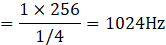
A 1 cm long string vibrates with fundamental frequency of 256 Hz. If the length is reduced to  keeping the tension unaltered, the new fundamental frequency will be
Text Solution
Verified by ExpertsThe correct answer is:
D
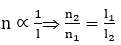
⇒ ⇒ 
Prepare Smarter with CGP Edu
Get practice questions, solutions, and test series in one place.
Write a Review
Share your experience with this question and solution.
Commentary
Send your comment, doubt, correction, or feedback to admin.
Similar Questions
Explore conceptually related problems
A string fixed at both the ends is vibrating in two segments. The wavelength of the corresponding t…
The velocity of waves in a string fixed at both ends is 2 m/s. The string forms standing waves with…
Which of the following is the example of transverse wave
A stretched string of 1m length and mass is having tension of 20N. If it is plucked at 25cm from o…
Two similar sonometer wires given fundamental frequencies of 500 Hz . These have same tensions. By …
A string is producing transverse vibration whose equation is , Where x and y are in meters and is…