Published by:
CGP EDU Academic Team
Published on: September 11, 2026
The source producing sound and an observer both are moving along the direction of propagation of sound waves. If the respective velocities of sound, source and an observer are v, $v_s$ and $v_o$ , then the apparent frequency heard by the observer will be (n = frequency of sound)
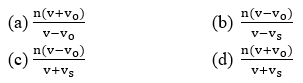
(a) $\frac{n(v+v_o)}{v-v_o}$ (b) $\frac{n(v-v_o)}{v-v_s}$ (c) $\frac{n(v-v_o)}{v+v_s}$ (d) $\frac{n(v+v_o)}{v+v_s}$
Text Solution
Verified by ExpertsThe correct answer is:
A
Step 1: Understanding the Doppler Effect
The Doppler Effect describes the change in frequency of a wave in relation to an observer moving relative to the source of the wave. When both the source and the observer are moving towards each other, the frequency increases.
Step 2: Setting Up Variables
Let:
- v = speed of sound
- vs = speed of the source
- vo = speed of the observer
- n = frequency of the sound emitted by the source.
Step 3: Applying the Doppler Effect Formula
When both the source and observer are moving towards each other, the formula for the apparent frequency (n') is given by:
$$ n' = n \frac{(v + v_o)}{(v - v_s)} $$
This takes into consideration the relative velocities of the source and observer with respect to the medium (air in this case).
Step 4: Identifying the Correct Option
From the provided options, we can see that option (a) matches the formula derived above:
$$ n' = n \frac{(v + v_o)}{(v - v_s)} $$
Therefore, the correct answer is: A.
The Doppler Effect describes the change in frequency of a wave in relation to an observer moving relative to the source of the wave. When both the source and the observer are moving towards each other, the frequency increases.
Step 2: Setting Up Variables
Let:
- v = speed of sound
- vs = speed of the source
- vo = speed of the observer
- n = frequency of the sound emitted by the source.
Step 3: Applying the Doppler Effect Formula
When both the source and observer are moving towards each other, the formula for the apparent frequency (n') is given by:
$$ n' = n \frac{(v + v_o)}{(v - v_s)} $$
This takes into consideration the relative velocities of the source and observer with respect to the medium (air in this case).
Step 4: Identifying the Correct Option
From the provided options, we can see that option (a) matches the formula derived above:
$$ n' = n \frac{(v + v_o)}{(v - v_s)} $$
Therefore, the correct answer is: A.
Prepare Smarter with CGP Edu
Get practice questions, solutions, and test series in one place.
Write a Review
Share your experience with this question and solution.
Commentary
Send your comment, doubt, correction, or feedback to admin.
Similar Questions
Explore conceptually related problems
Doppler shift in frequency does not depend upon
A source of sound of frequency 450 cycles/sec is moving towards a stationary observer with 34 m/sec…
The wavelength is 120 cm when the source is stationary. If the source is moving with relative veloc…
The frequency of a whistle of an engine is 600 cycles/sec is moving with the speed of 30 m/sec towa…
A source of sound emits waves with frequency f Hz and speed V m/sec. Two observers move away from t…
An observer moves towards a stationary source of sound of frequency n. The apparent frequency heard…