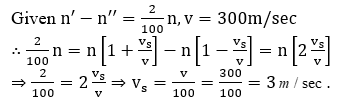
The difference between the apparent frequency of a source of sound as perceived by an observer during its approach and recession is 2% of the natural frequency of the source. If the velocity of sound in air is 300 m/sec, the velocity of the source is (It is given that velocity of source << velocity of sound)
Text Solution
Verified by ExpertsThe correct answer is:
B
When the source approaches the observer
Apparent frequency 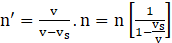
= 
(Neglecting higher powers because v S << v)
When the source recedes the observed apparent frequency 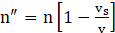
Prepare Smarter with CGP Edu
Get practice questions, solutions, and test series in one place.
Write a Review
Share your experience with this question and solution.
Commentary
Send your comment, doubt, correction, or feedback to admin.
Similar Questions
Explore conceptually related problems
A tuning fork vibrating with a sonometer having 20 cm wire produces 5 beats per second. The beat fr…
A stretched string of length l fixed at both ends can sustain stationary waves of wavelength given…
A string of 7 m length has a mass of 0.035 kg. If tension in the string is 60.5 N, then speed of a …
Two wires are in unison. If the tension in one of the wires is increased by 2%, 5 beats are produce…
Two passenger trains moving with a speed of 108 km/hour cross each other. One of them blows a whist…
A source of sound is travelling towards a stationary observer. The frequency of sound heard by the …