Two wires of resistance  and
and  have temperature coefficient of resistance
  and
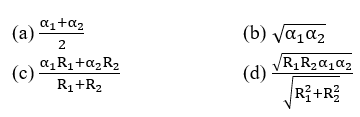
and  , respectively. These are joined in series. The effective temperature coefficient of resistance is
Text Solution
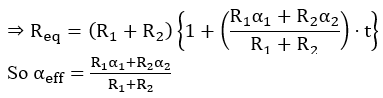
Verified by ExpertsThe correct answer is:
C

Also 

Prepare Smarter with CGP Edu
Get practice questions, solutions, and test series in one place.
Write a Review
Share your experience with this question and solution.
Commentary
Send your comment, doubt, correction, or feedback to admin.
Similar Questions
Explore conceptually related problems
In an electrical cable there is a single wire of radius 9 mm of copper. Its resistance is 5 Ω Ω . T…
Two uniform wires A and B are of the same metal and have equal masses. The radius of wire A is twic…
Twelve wires of equal length and same cross-section are connected in the form of a cube. If the res…
The resistance of a wire is per meter. It is bend in the form of a circle of diameter 2m. A wire o…
When the key K is pressed at time t = 0, which of the following statements about the current I in t…
A torch bulb rated as 4.5 W, 1.5 V is connected as shown in the figure. The e.m.f. of the cell need…