Published by:
CGP EDU Academic Team
Published on: September 12, 2026
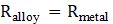
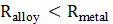
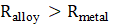
The resistivity of alloys
; the resistivity of constituent metals
. Then, usually
Text Solution
Verified by ExpertsThe correct answer is:
C
When alloys are formed from metals, their resistivity can vary significantly compared to that of their constituent metals.
Step 1: For pure metals, the resistivity is generally lower than that of alloys due to the enhanced electron mobility in pure metals compared to their alloyed counterparts.
Step 2: This means that the resistivity of alloys can be less or greater than that of the pure metals depending on the particular mixture and the interactions between the metal atoms.
Step 3: Since there is no straightforward relationship that universally applies to all alloys and their constituent metals, the best answer is that there is no simple relation between the resistivity of the alloy and its constituent metals.
Therefore, the correct option is C.
Step 1: For pure metals, the resistivity is generally lower than that of alloys due to the enhanced electron mobility in pure metals compared to their alloyed counterparts.
Step 2: This means that the resistivity of alloys can be less or greater than that of the pure metals depending on the particular mixture and the interactions between the metal atoms.
Step 3: Since there is no straightforward relationship that universally applies to all alloys and their constituent metals, the best answer is that there is no simple relation between the resistivity of the alloy and its constituent metals.
Therefore, the correct option is C.
Prepare Smarter with CGP Edu
Get practice questions, solutions, and test series in one place.
Write a Review
Share your experience with this question and solution.
Commentary
Send your comment, doubt, correction, or feedback to admin.
Similar Questions
Explore conceptually related problems
Current of 4.8 amperes is flowing through a conductor. The number of electrons per second will be
Every atom makes one free electron in copper. If 1.1 ampere current is flowing in the wire of coppe…
Which one is not the correct statement
The temperature coefficient of resistance for a wire is 0.00125° C . At 300K its resistance is 1 oh…
Ohm's law is true
The example for non-ohmic resistance is
and