An equiconvex lens is cut into two halves along (i) XOX ′ ′ and (ii) YOY ′ ′ as shown in the figure. Let f, f ′ ′ , f ′ ′ ′ ′ be the focal lengths of the complete lens, of each half in case (i), and of each half in case (ii), respectively
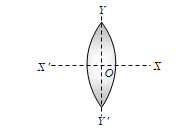
Choose the correct statement from the following
A

B

C

D

Text Solution
Verified by ExpertsThe correct answer is:
D
No detailed text explanation provided yet.
Prepare Smarter with CGP Edu
Get practice questions, solutions, and test series in one place.
Write a Review
Share your experience with this question and solution.
Commentary
Send your comment, doubt, correction, or feedback to admin.
Similar Questions
Explore conceptually related problems
Chromatic aberration of lens can be corrected by
The relation between n 1 and n 2 , if behaviour of light rays is as shown in figure is
The focal length of a convex lens is 10 cm and its refractive index is 1.5. If the radius of curvat…
A convex lens forms a real image of an object for its two different positions on a screen. If heigh…
Figure given below shows a beam of light converging at point P . When a convex lens of focal length…
If two + 5 D lenses are mounted at some distance apart, the equivalent power will always be negativ…