Home Physics Newton's Laws of Motion Motion of Connected Bodies In the figure shown, when the persons A and …
Physics Newton's Laws of Motion Motion of Connected Bodies Subjective Type
Published on: September 12, 2026

In the figure shown, when the persons A and B exchange their positions, then
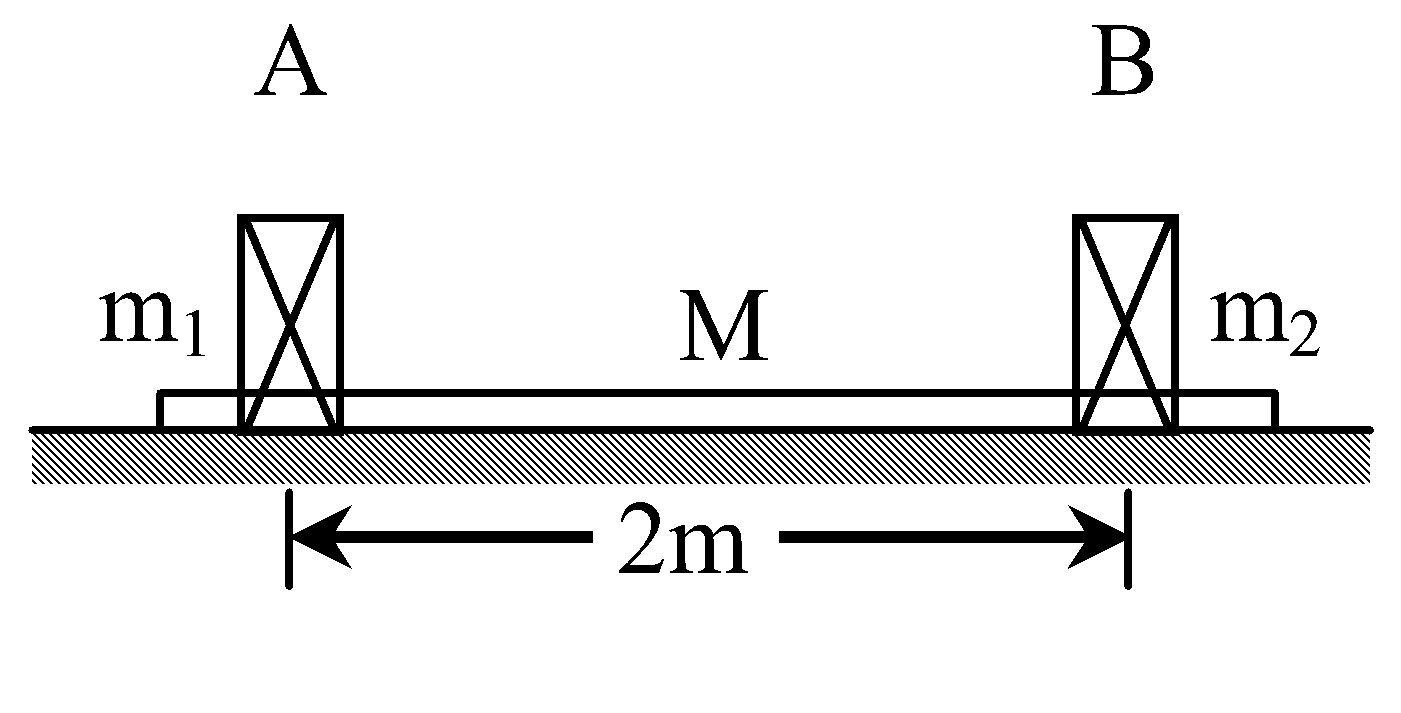
m 1 = 50 kg, m 2 = 70 kg, M = 80 kg

(i) The distance moved by the centre of mass of the system is ..................

(ii) The plank moves toward .................

(iii) The distance moved by the plank is ..........

(iv) The distance moved by A with respect to ground is ..................

(v) The distance moved by B with respect to ground is ................

Share this question

For Instagram sharing, use “Apps” on mobile or copy the link.

Text Solution

Verified by Experts
The correct answer is:
A
Given Data:
Mass of person A (m1) = 50 kg
Mass of person B (m2) = 70 kg
Mass of the plank (M) = 80 kg
Length of the plank = 2 m

Step 1: Calculate the Initial Position of the Center of Mass
The center of mass (CM) of the system can be found using the formula:
$$ CM = \frac{m_1 x_1 + m_2 x_2 + M x_M}{m_1 + m_2 + M} $$
Assuming initial positions:
Let A be at x1 = 0 m (left end) and B be at x2 = 2 m (right end). The plank's center is located at its midpoint, xM = 1 m.

Inserting the values:
$$ CM_{initial} = \frac{(50 \times 0) + (70 \times 2) + (80 \times 1)}{50 + 70 + 80} = \frac{0 + 140 + 80}{200} = \frac{220}{200} = 1.1 \text{ m} $$

Step 2: Calculate the Final Position of the Center of Mass
When A and B switch positions, A is now at x1 = 2 m and B is at x2 = 0 m.

Calculating the new center of mass:
$$ CM_{final} = \frac{(50 \times 2) + (70 \times 0) + (80 \times 1)}{50 + 70 + 80} = \frac{(100 + 0 + 80)}{200} = \frac{180}{200} = 0.9 \text{ m} $$

Step 3: Distance Moved by the Center of Mass
The change in the location of the center of mass is:
$$ \Delta CM = CM_{final} - CM_{initial} = 0.9 - 1.1 = -0.2 \text{ m} $$
Thus, the center of mass moves 0.2 m towards the left.

Step 4: Direction of the Plank Movement
Since the center of mass moved to the left, the plank must move to the right to conserve momentum. Therefore, it moves towards the right.

Step 5: Calculate the Distance Moved by the Plank
The distance moved by the plank (dP) can be found using:
$$ d_P = \frac{m_2}{m_1 + m_2 + M} \times \Delta CM $$
Inserting the values:
$$ d_P = \frac{70}{200} \times 0.2 = 0.07 \text{ m} $$
This value indicates how much the plank shifts to the right.

Step 6: Distance Moved by A and B with Respect to the Ground
A moves from x = 0 m to x = 2 m, thus moves:
$$ d_A = 2 - 1.1 = 0.9 \text{ m (to right)} $$
B moves from x = 2 m to x = 0 m, thus moves:
$$ d_B = 0 - 1.1 = -1.1 \text{ m (to left)} $$

Conclusion:
i) The distance moved by the center of mass of the system is 0.2 m to the left.
ii) The plank moves toward the right.
iii) The distance moved by the plank is 0.07 m.
iv) The distance moved by A with respect to ground is 0.9 m.
v) The distance moved by B with respect to ground is -1.1 m.

Prepare Smarter with CGP Edu

Get practice questions, solutions, and test series in one place.

Write a Review

Share your experience with this question and solution.

Commentary

Send your comment, doubt, correction, or feedback to admin.

Student Reviews

What students say about this solution

No reviews yet. Be the first to write a review.

Similar Questions

Explore conceptually related problems

CG
CGP Question Assistant Question Bank + AI Help
Hi! Type your question or upload one screenshot. First I will search related questions from CGP Edu Question Bank. If none match, type YES and I will solve it with AI.
Upload only one screenshot at a time. Flow: Question Bank first → If not matched, type YES for AI solution.