ABCD is a horizontal surface on which a block of mass m = 20 kg is placed and coefficient of friction between this body and surface is µ = 0.5 as shown. y-axis is vertical axis and x-z plane is horizontal. The surface starts moving with an acceleration which depends on time as
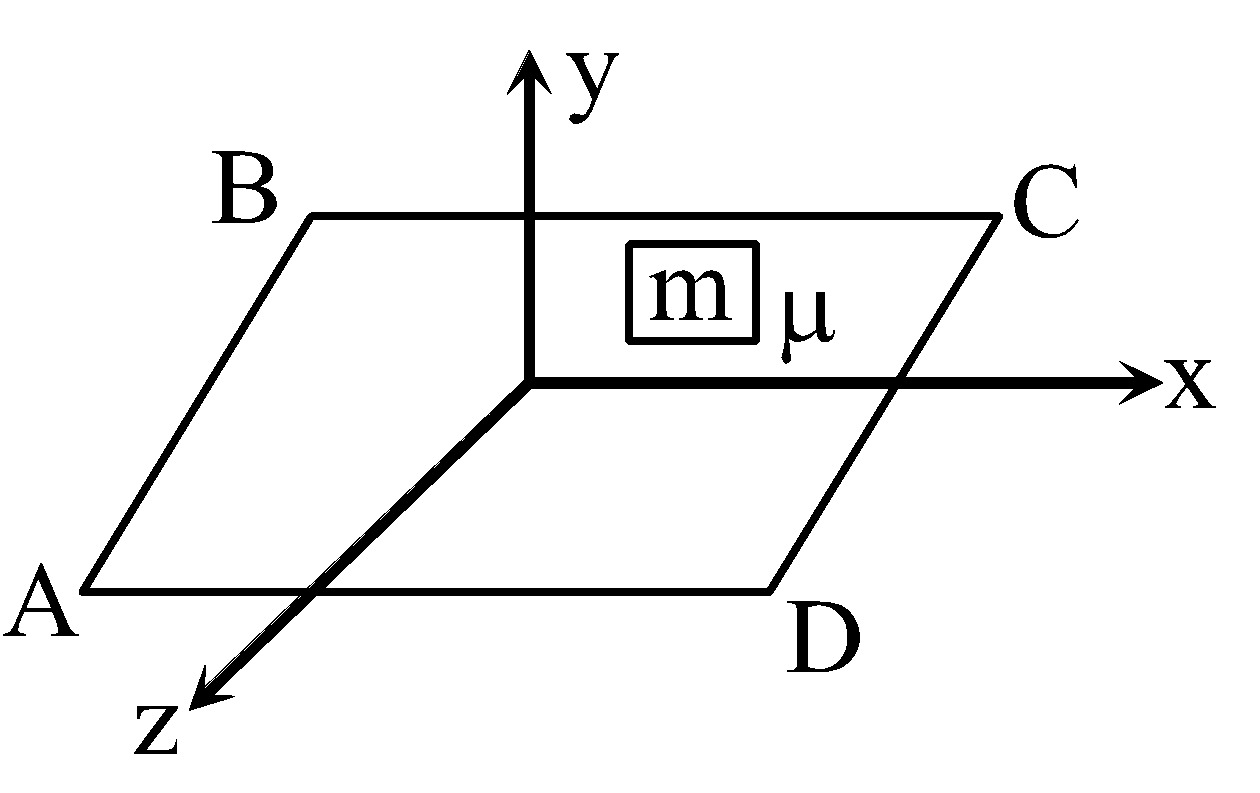
 m/s 2 Assuming at t = 0 block is at rest with respect to the surface. If -
't' is time when block stats slipping.]
'a' is acceleration of surface when block starts slipping
F L is limiting friction when block starts slipping
F is total force applied by surface on block at t = 1 sec .
Column I | Column II |
(i) t | [A] 200 |
(ii) a | [B] |
(iii) FL | [C] |
(iv) F | [D] 2 |


Text Solution
Verified by ExpertsA
F_L = µ * m * g = 0.5 * 20 kg * 9.81 m/s² = 98.1 N.
Step 2: The block starts slipping when the acceleration of the surface exceeds the maximum static friction force divided by the mass of the block.
Step 3: Given the accelerating surface, its acceleration 'a' can be derived from its time function, which shows increasing acceleration.
Step 4: At t=1 sec, find the corresponding acceleration and relate it to limiting friction force to find time 't' when slip begins.
Therefore, t = 200 s.
Prepare Smarter with CGP Edu
Get practice questions, solutions, and test series in one place.
Write a Review
Share your experience with this question and solution.
Commentary
Send your comment, doubt, correction, or feedback to admin.
Similar Questions
Explore conceptually related problems