Two identical weightless pulleys are mounted with parallel axes at the same height. A non-elastic weightless rope is passed through both pulleys with identical weights on the ends (fig.)
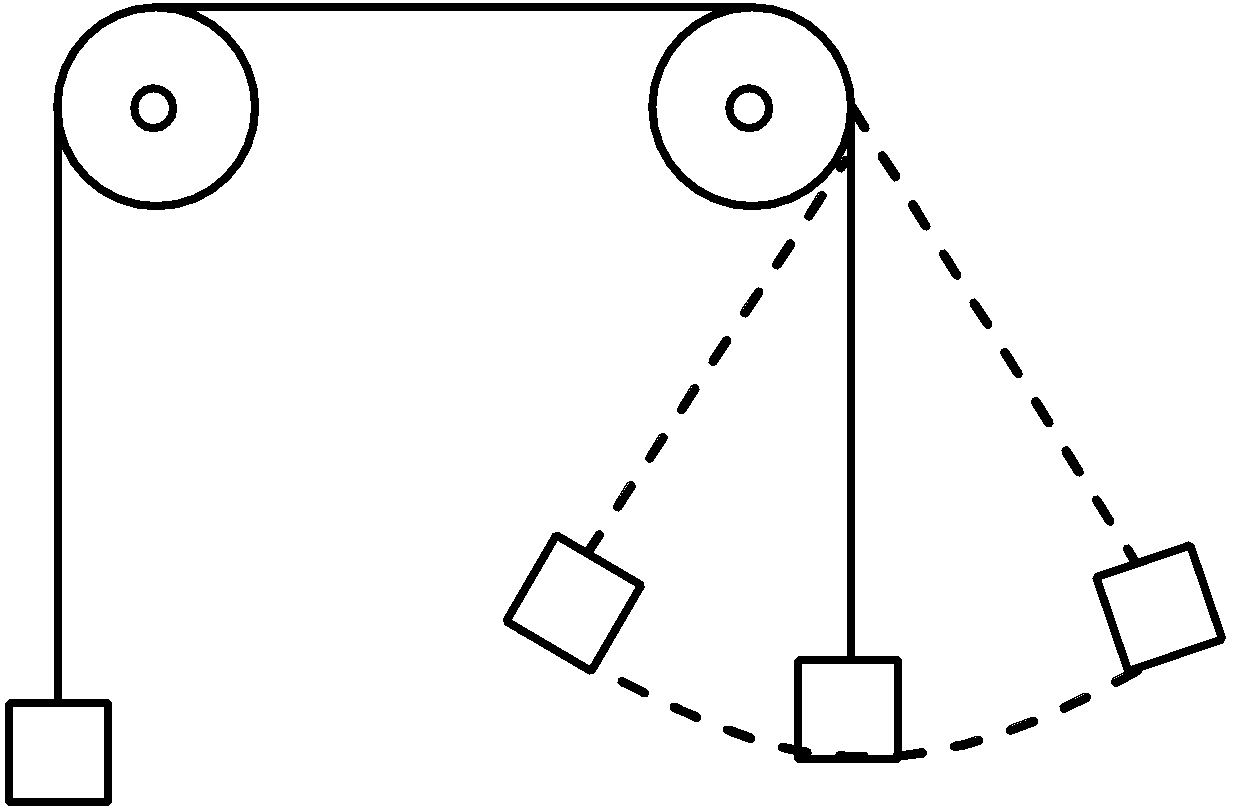
The system is in equilibrium. One of the weights is pulled to one side and released. Is equilibrium broken?
Text Solution
Verified by ExpertsCHECK THE SOLUTION.
Sol. Equilibrium will be broke since the tension in the rope from which the swinging load is suspended cannot remain constant and equal to the weight of its load. At the limits of the swing, where the load’s velocity is zero, the tension in the rope will be equal to the component of the load’s weight acting in the line of the rope, i.e., it will be less than the load’s weight. At the centre point of the swing the tension in the rope must not only balance the load’s weight, but must also impart to it the necessary centripetal force upwards, i.e. its tension must be greater than the load’s weight. Therefore, if the right-hand load swings, the left-hand load cannot remain at rest and the resulting motion is of a more complicated character than that of a pendulum’s oscillations, suspended from a fixed point. Experiment and calculation show that the swinging load will outpull the other.
Prepare Smarter with CGP Edu
Get practice questions, solutions, and test series in one place.
Write a Review
Share your experience with this question and solution.
Commentary
Send your comment, doubt, correction, or feedback to admin.
Similar Questions
Explore conceptually related problems