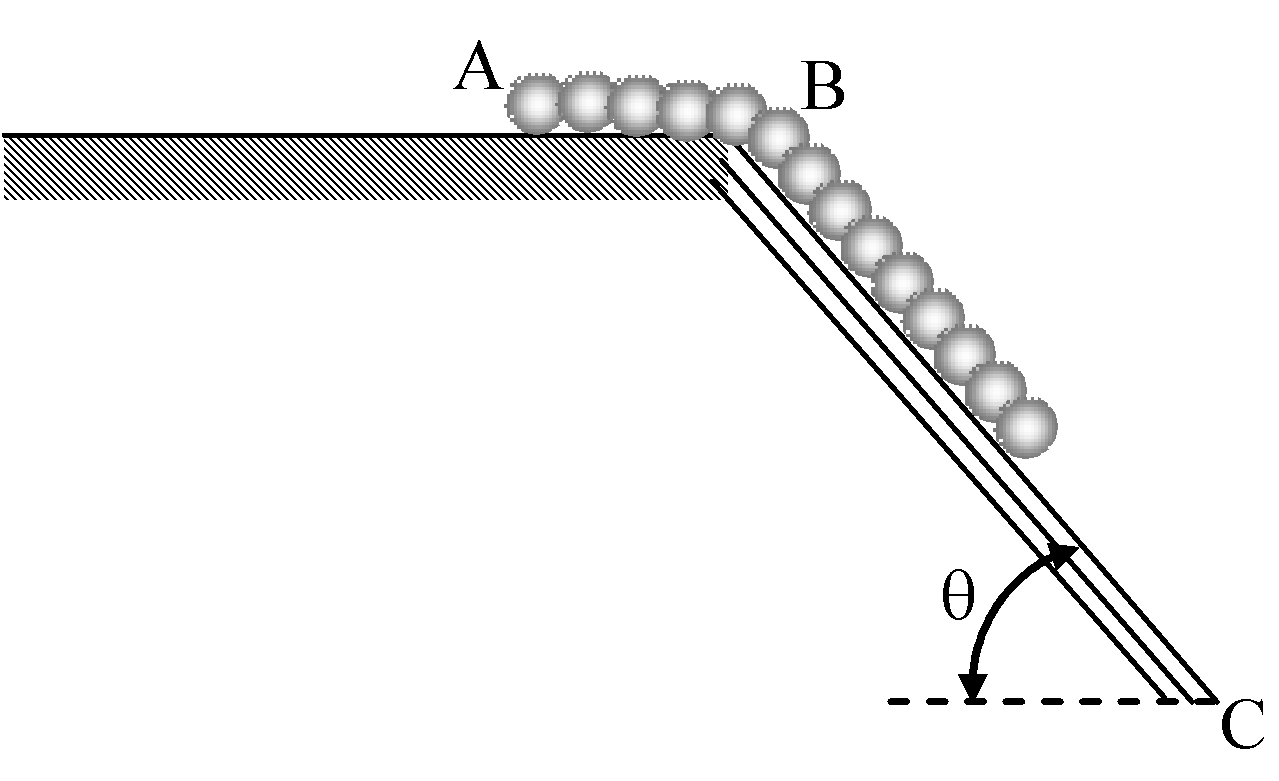
A chain of length L and mass m is placed upon a smooth surface (see. Figure). The length of  is L–b. Calculate the velocity of the chain when its end reaches B.
Text Solution
Verified by ExpertsCHECK THE SOLUTION.
Sol To solve this problem, we use the principle of conservation of energy. Let us denote by
y = 0 the plane  . It will be the reference plane of the potential energy. In changing its position from A to B, the chain's potential energy changes, and as a result, its velocity changes. The potential energy is calculated by integration over the length of the chain. The mass of the chain per unit length is λ =
  . The contribution of a piece of length dr to the potential energy is

du = –gh dm = – λ hgdr …...(i)
Where h = r sin θ (see figure). The initial potential energy is, therefore,
u i =  …...(ii)
Similarly, the final potential energy is :
u f =  …...(iii)
From the principle of conservation of energy, we know that:
E k(i) + u i = E k(f) + u f …...(iv)
Where E k(i) = 0 Hence,
E k(f) = u i – u f = 
 gsin θ (L 2 – b 2 )
  mv 2 …...(v)
From which follows
v =  …. (iv)
Prepare Smarter with CGP Edu
Get practice questions, solutions, and test series in one place.
Write a Review
Share your experience with this question and solution.
Commentary
Send your comment, doubt, correction, or feedback to admin.
Similar Questions
Explore conceptually related problems