Published by:
CGP EDU Academic Team
Published on: September 12, 2026
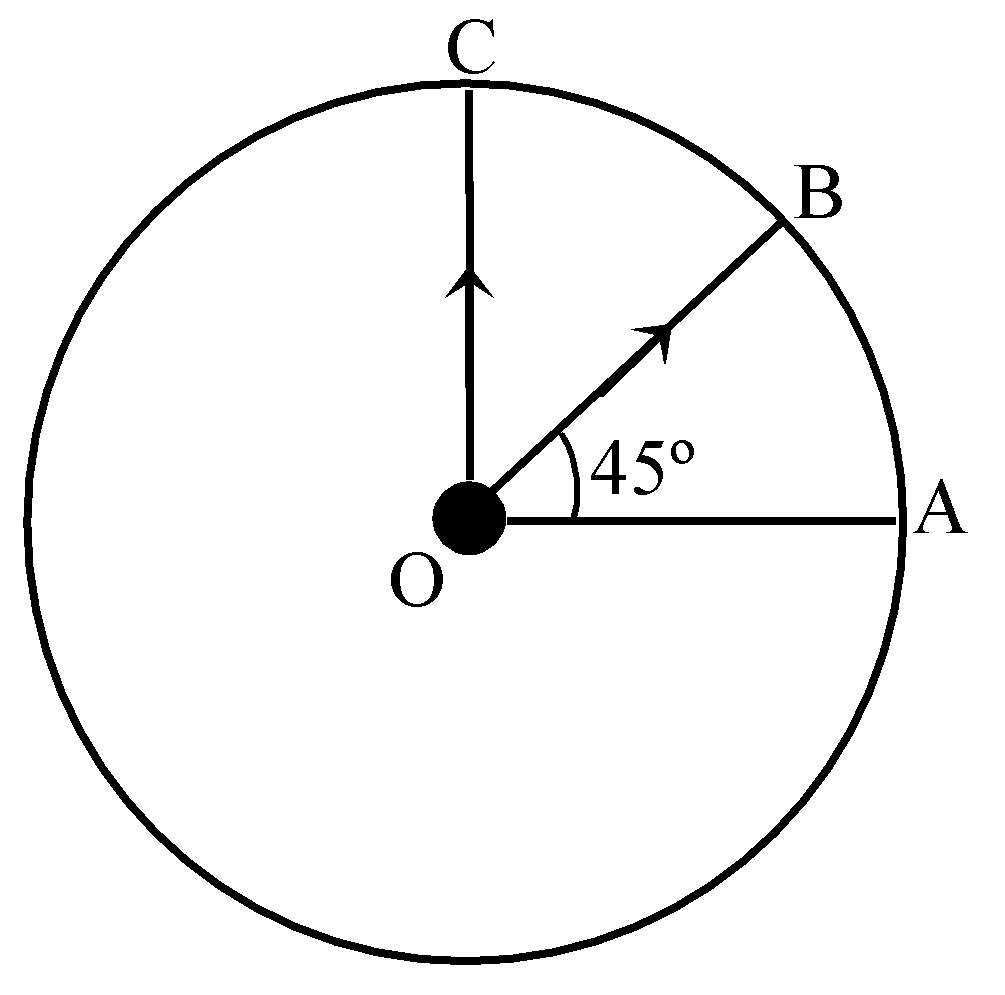
Find the resultant of three vectors  and
and  as shown in figure. Radius of the circle is
  .
.
Text Solution
Verified by ExpertsThe correct answer is:
A
To find the resultant of the three vectors \\( \vec{OA}, \vec{OB}, \vec{OC} \\), we start by defining the vectors and their magnitudes. Given the angles and the radius of the circle (let's denote it as \( r \\)), we can use trigonometric functions to resolve the components of each vector.
Step 1: Decompose each vector into its x and y components:
- For \( \vec{OA} \):
\( OA_x = r \cdot \cos(90^\circ) = 0 \)
\( OA_y = r \cdot \sin(90^\circ) = r \)
- For \( \vec{OB} \):
\( OB_x = r \cdot \cos(45^\circ) = \frac{r}{\sqrt{2}} \)
\( OB_y = r \cdot \sin(45^\circ) = \frac{r}{\sqrt{2}} \)
- For \( \vec{OC} \):
\( OC_x = r \cdot \cos(0^\circ) = r \)
\( OC_y = r \cdot \sin(0^\circ) = 0 \)
Step 2: Now, sum the components:
\( R_x = OA_x + OB_x + OC_x = 0 + \frac{r}{\sqrt{2}} + r = r + \frac{r}{\sqrt{2}} \)
\( R_y = OA_y + OB_y + OC_y = r + \frac{r}{\sqrt{2}} + 0 = r + \frac{r}{\sqrt{2}} \)
Step 3: Calculate the magnitude of the resultant vector \( R \):
\( R = \sqrt{R_x^2 + R_y^2}
R = \sqrt{ \left( r + \frac{r}{\sqrt{2}} \right)^2 + \left( r + \frac{r}{\sqrt{2}} \right)^2 } = \sqrt{2 \left( r + \frac{r}{\sqrt{2}} \right)^2} = \sqrt{2} \left( r + \frac{r}{\sqrt{2}} \right)
= \sqrt{2}r \left( 1 + \frac{1}{\sqrt{2}} \right)
Therefore, the resultant vector \( \vec{R} \) can be calculated and simplified further if needed.
Step 1: Decompose each vector into its x and y components:
- For \( \vec{OA} \):
\( OA_x = r \cdot \cos(90^\circ) = 0 \)
\( OA_y = r \cdot \sin(90^\circ) = r \)
- For \( \vec{OB} \):
\( OB_x = r \cdot \cos(45^\circ) = \frac{r}{\sqrt{2}} \)
\( OB_y = r \cdot \sin(45^\circ) = \frac{r}{\sqrt{2}} \)
- For \( \vec{OC} \):
\( OC_x = r \cdot \cos(0^\circ) = r \)
\( OC_y = r \cdot \sin(0^\circ) = 0 \)
Step 2: Now, sum the components:
\( R_x = OA_x + OB_x + OC_x = 0 + \frac{r}{\sqrt{2}} + r = r + \frac{r}{\sqrt{2}} \)
\( R_y = OA_y + OB_y + OC_y = r + \frac{r}{\sqrt{2}} + 0 = r + \frac{r}{\sqrt{2}} \)
Step 3: Calculate the magnitude of the resultant vector \( R \):
\( R = \sqrt{R_x^2 + R_y^2}
R = \sqrt{ \left( r + \frac{r}{\sqrt{2}} \right)^2 + \left( r + \frac{r}{\sqrt{2}} \right)^2 } = \sqrt{2 \left( r + \frac{r}{\sqrt{2}} \right)^2} = \sqrt{2} \left( r + \frac{r}{\sqrt{2}} \right)
= \sqrt{2}r \left( 1 + \frac{1}{\sqrt{2}} \right)
Therefore, the resultant vector \( \vec{R} \) can be calculated and simplified further if needed.
Prepare Smarter with CGP Edu
Get practice questions, solutions, and test series in one place.
Write a Review
Share your experience with this question and solution.
Commentary
Send your comment, doubt, correction, or feedback to admin.
Similar Questions
Explore conceptually related problems
There are two force vectors, one of 5 N and other of 12 N at what angle the two vectors be added to…
If \vec{A} = 4\hat{i} - 3\hat{j} and \vec{B} = 6\hat{i} + 8\hat{j} then magnitude and direction of …
A truck travelling due north at 20 m/s turns west and travels at the same speed. The change in its …
If the sum of two unit vectors is a unit vector, then magnitude of difference is
\vec{A} = 2\hat{i} + \hat{j}, \vec{B} = 3\hat{j} - \hat{k} and \vec{c} = 6\hat{i} - 2\hat{k} , Valu…
An object of m kg with speed of v m/s strikes a wall at an angle q and rebounds at the same speed…