To anticipate the dip and hump in the road the driver of a car applies her brakes to produce a uniform deceleration. Her speed is 100km/h at the bottom A of the dip and 50km/h at the top C of the hump, which is 120m along the road from A. If the passengers experience a total acceleration of 3m/s 2 at A and if the radius of curvature of the hump at C is 150m. calculate '
 at A,
at A,
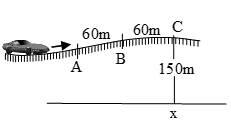
Text Solution
Verified by ExpertsCHECK THE SOLUTION.
Sol. The dimensions of the car are small compared with those of the path, so we will treat the car as a particle. The velocities are
v A = 

 = 27.8 m/s
v C = 50  = 13.89 m/s
We find the constant deceleration along the path from


a t =  (v C 2 – v A 2 ) =
  = –2.41 m/s 2 Condition at A.

With the total acceleration given and a t determined, we can easily compute a n and hence ρ from
[a
2 = a n 2 + a t 2 ] a n 2 = 3 2 – (2.41) 2 = 3.19 a n = 1.785 m/s 2 [a n = v
2 / ρ ] ρ = v 2 /a n = (27.8) 2 /1.785 = 432 m . Ans.
Condition at B.

Since the radius of curvature is infinite at the inflection
point, a n = 0 and a = a t = –2.41 m/s 2 Condition at C.

The normal acceleration becomes
[a n = v
2 / ρ ] a n = (13.89) 2 /150 = 1.286 m/s 2 With unit vectors e n and e t in the n-and t-directions, the acceleration may be written
a = 1.286e n – 2.41 e t m/s
2 where the magnitude of a is
[a =  ] a=
] a=  = 2.73 m/s
2 Ans.
The acceleration vectors representing the conditions at each of the three points are shown for clarification.
Prepare Smarter with CGP Edu
Get practice questions, solutions, and test series in one place.
Write a Review
Share your experience with this question and solution.
Commentary
Send your comment, doubt, correction, or feedback to admin.
Similar Questions
Explore conceptually related problems