Published by:
CGP EDU Academic Team
Published on: September 12, 2026
In Fig., the capacitors have plate area A = l × b, separation 'd'.
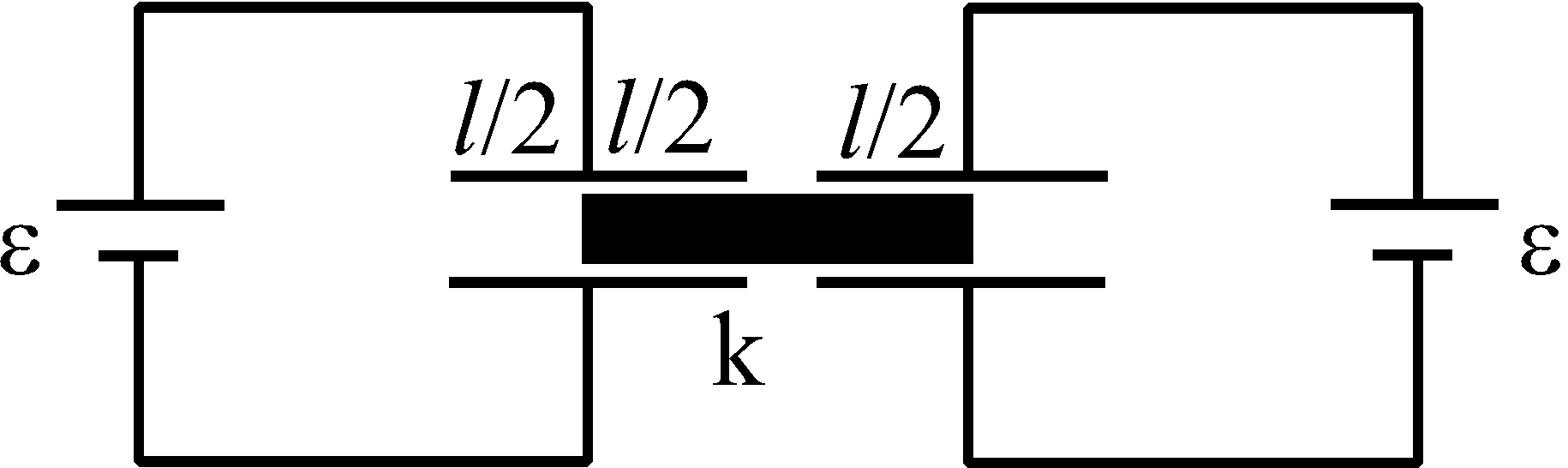
If the slab is displaced slightly, find the time period of the oscillation. Is it simple harmonic? Given mass of the dielectric = m.
Text Solution
Verified by ExpertsThe correct answer is:
A
Step 1: Analyzing the System
The system consists of a parallel plate capacitor with a dielectric slab of mass 'm' that can oscillate. When the slab is displaced by a distance 'x' from its equilibrium position, the distance between the plates changes, which affects the capacitance.
Step 2: Expression for Capacitance
The capacitance of a parallel plate capacitor is given by:
$C = \frac{\varepsilon_0 A}{d - x}$
where $A = l \times b$ is the area of the plates and $d$ is the separation. Here, we denote $\\varepsilon_0$ as the permittivity of free space.
Step 3: Force on the Slab
The electric field $E$ between the plates is given by:
$E = \frac{V}{d - x}$
where V is the voltage applied across the capacitor.
The force F acting on the slab due to the electric field is:
$F = qE = C(V^2)\frac{1}{d - x}$
Substituting the value of capacitance, we have:
$F = \frac{\varepsilon_0 A V^2}{d - x}.$
Step 4: Equation of Motion
The upward force on the slab leads to a restoring force when it is displaced, which can be modeled as:
$F = m g + k x$
where k is the effective spring constant.
For small displacements (assuming SHM), we can write:
$m a = -k x,$
which is the form of Hooke's law.
Step 5: Finding the Time Period
The angular frequency $\omega$ of the oscillator is:
$\omega = \sqrt{\frac{k}{m}}$
The time period T is:
$T = 2\pi \sqrt{\frac{m}{k}}$
This confirms that the oscillation is simple harmonic as it follows the form $F = -kx$. Thus, the system indeed oscillates with SHM, and the time period is confirmed to be:
$T = 2\pi \sqrt{\frac{m}{k}}$
Therefore, the time period of the oscillation is $T = 2\pi \sqrt{\frac{m}{K}}$ where K represents the effective spring constant determined from the system's parameters.
The system consists of a parallel plate capacitor with a dielectric slab of mass 'm' that can oscillate. When the slab is displaced by a distance 'x' from its equilibrium position, the distance between the plates changes, which affects the capacitance.
Step 2: Expression for Capacitance
The capacitance of a parallel plate capacitor is given by:
$C = \frac{\varepsilon_0 A}{d - x}$
where $A = l \times b$ is the area of the plates and $d$ is the separation. Here, we denote $\\varepsilon_0$ as the permittivity of free space.
Step 3: Force on the Slab
The electric field $E$ between the plates is given by:
$E = \frac{V}{d - x}$
where V is the voltage applied across the capacitor.
The force F acting on the slab due to the electric field is:
$F = qE = C(V^2)\frac{1}{d - x}$
Substituting the value of capacitance, we have:
$F = \frac{\varepsilon_0 A V^2}{d - x}.$
Step 4: Equation of Motion
The upward force on the slab leads to a restoring force when it is displaced, which can be modeled as:
$F = m g + k x$
where k is the effective spring constant.
For small displacements (assuming SHM), we can write:
$m a = -k x,$
which is the form of Hooke's law.
Step 5: Finding the Time Period
The angular frequency $\omega$ of the oscillator is:
$\omega = \sqrt{\frac{k}{m}}$
The time period T is:
$T = 2\pi \sqrt{\frac{m}{k}}$
This confirms that the oscillation is simple harmonic as it follows the form $F = -kx$. Thus, the system indeed oscillates with SHM, and the time period is confirmed to be:
$T = 2\pi \sqrt{\frac{m}{k}}$
Therefore, the time period of the oscillation is $T = 2\pi \sqrt{\frac{m}{K}}$ where K represents the effective spring constant determined from the system's parameters.
Prepare Smarter with CGP Edu
Get practice questions, solutions, and test series in one place.
Write a Review
Share your experience with this question and solution.
Commentary
Send your comment, doubt, correction, or feedback to admin.
Similar Questions
Explore conceptually related problems
The capacity of a parallel plate condenser is . When a glass plate is placed between the plates of…
A capacitor is charged by using a battery which is then disconnected. A dielectric slab is then sli…
The energy of a charged capacitor is given by the expression ( $\alpha$ = charge on the conductor a…
The capacity of a condenser is $4 \times 10^{-6}$ farad and its potential is 100 volts . The energy…
The insulated spheres of radii $R_1$ and $R_2$ having charges $Q_1$ and $Q_2$ respectively are conn…
In a charged capacitor, the energy resides