In figure, a conducting spherical shell of inner radius 'x' and outer radius 'y' is concentric with a larger conducting spherical shell of inner radius 'a' and outer radius 'b'. The inner shell has a total charge + 3Q and the outer shell has a total charge +5Q. Let 'r' be the distance of any point from the common center O. Match Column – I with Column – II:
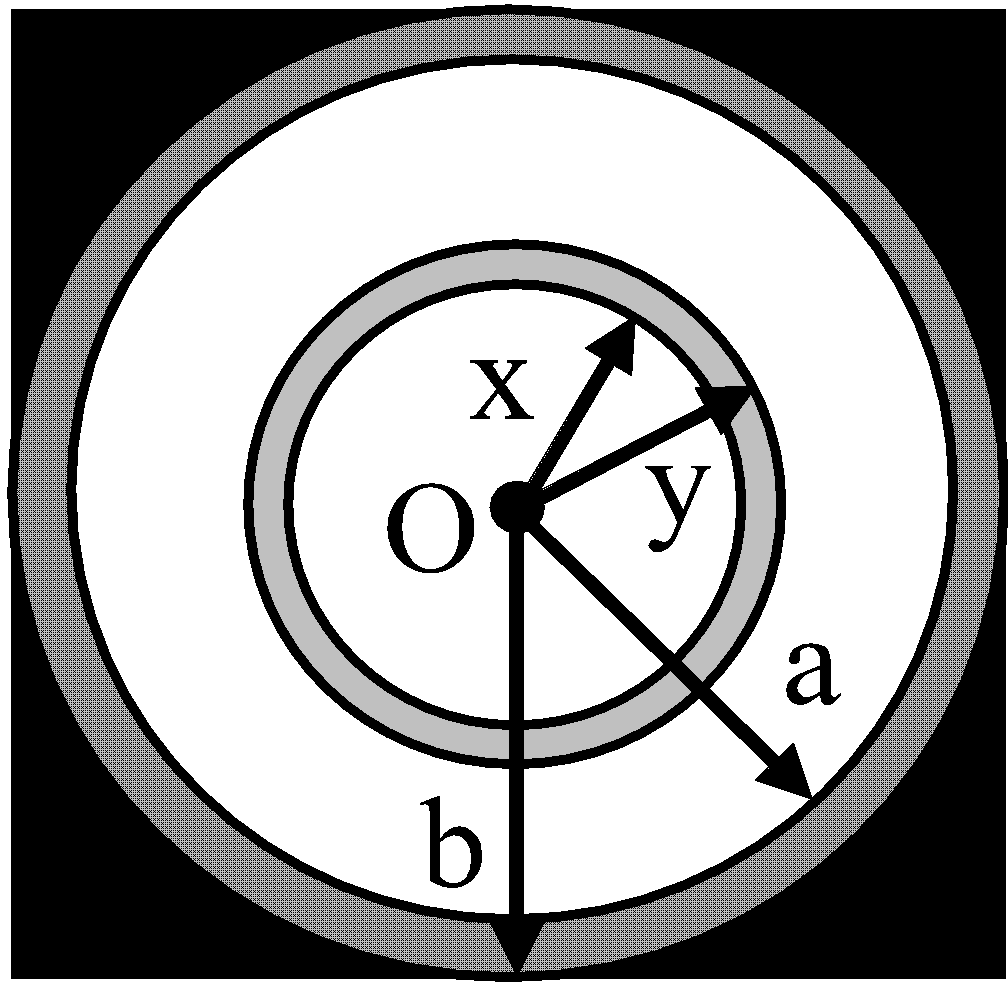
Column-I | Column-II |
(i) Electric field strength is Zero | [A] Outer surface of the larger spherical Shell |
(ii) Electric field strength is non-zero | [B] Inner surface of the larger spherical Shell |
(iii) Magnitude of charge on this surface is 3 Q | [C] Outer surface of the smaller spherical Shell |
(iv) Charge on this surface is + 8Q | [D] For a < r < b |
Text Solution
Verified by ExpertsCHECK THE SOLUTION.
Ans.
(i) [D]
(ii) [A],[B],[C]
(iii) [B],[C]
(iv) [A]
Sol.
(i) For a < r < b
(ii) Outer surface of the larger spherical Shell, Inner surface of the larger spherical Shell, Outer surface of the smaller spherical Shell.
(iii) Inner surface of the larger spherical Shell, Outer surface of the smaller spherical Shell
(iv) Outer surface of the larger spherical Shell
Prepare Smarter with CGP Edu
Get practice questions, solutions, and test series in one place.
Write a Review
Share your experience with this question and solution.
Commentary
Send your comment, doubt, correction, or feedback to admin.
Similar Questions
Explore conceptually related problems