Published by:
CGP EDU Academic Team
Published on: September 12, 2026
Will Torricelli's experiment work if a barometric tube filled with mercury be placed with its open end not in a vessel containing mercury, but in vessel containing water (Fig.)?
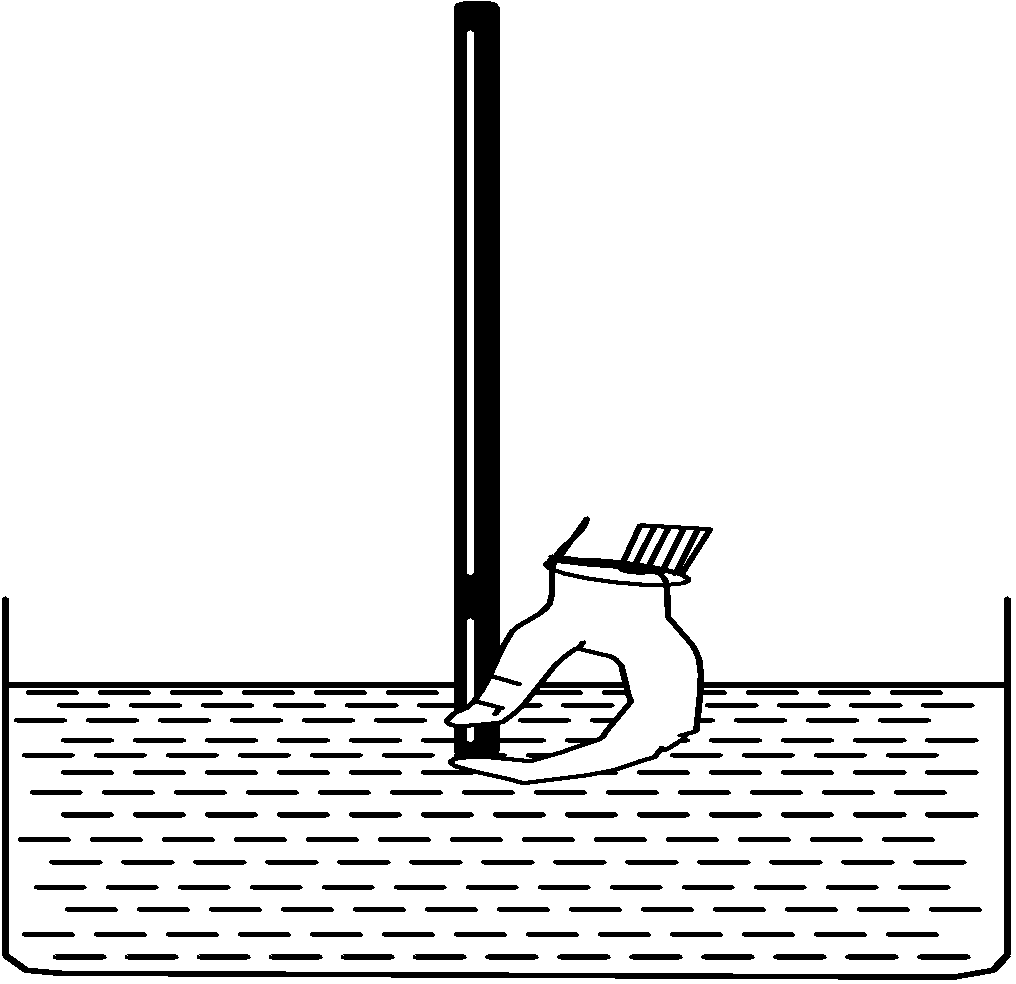
Text Solution
Verified by ExpertsThe correct answer is:
No
Step 1: Torricelli's experiment demonstrates that atmospheric pressure can support a column of mercury in a barometer. The height of the mercury column is maintained due to the balance between atmospheric pressure and the weight of the mercury.
Step 2: If the open end of the barometric tube is placed in a vessel containing water instead of mercury, the density of water (approximately 1000 kg/m³) is much lower than that of mercury (approximately 13600 kg/m³).
Step 3: The pressure exerted by a column of liquid is given by the formula: $P = h imes ho imes g$, where $P$ is the pressure, $h$ is the height of the liquid column, $ ho$ is the density of the liquid, and $g$ is the acceleration due to gravity.
Step 4: Since water's density is much less than mercury, to exert the same pressure at the open end of the barometer, the height of the water column would need to be greater. This would be significantly higher than the height of the mercury that normally stands at about 760 mm.
Step 5: The low density of water would result in the mercury not rising in the tube to the level needed to counterbalance atmospheric pressure. Therefore, the experiment will not function correctly due to the mismatch in densities.
Therefore, the answer is: No.
Step 2: If the open end of the barometric tube is placed in a vessel containing water instead of mercury, the density of water (approximately 1000 kg/m³) is much lower than that of mercury (approximately 13600 kg/m³).
Step 3: The pressure exerted by a column of liquid is given by the formula: $P = h imes ho imes g$, where $P$ is the pressure, $h$ is the height of the liquid column, $ ho$ is the density of the liquid, and $g$ is the acceleration due to gravity.
Step 4: Since water's density is much less than mercury, to exert the same pressure at the open end of the barometer, the height of the water column would need to be greater. This would be significantly higher than the height of the mercury that normally stands at about 760 mm.
Step 5: The low density of water would result in the mercury not rising in the tube to the level needed to counterbalance atmospheric pressure. Therefore, the experiment will not function correctly due to the mismatch in densities.
Therefore, the answer is: No.
Prepare Smarter with CGP Edu
Get practice questions, solutions, and test series in one place.
Write a Review
Share your experience with this question and solution.
Commentary
Send your comment, doubt, correction, or feedback to admin.
Similar Questions
Explore conceptually related problems
A U-tube in which the cross-sectional area of the limb on the left is one quarter, the limb on the …
A wooden block, with a coin placed on its top, floats in water as shown in fig. the distance l and …
A body floats in a liquid contained in a beaker. The whole system as shown falls freely under gravi…
A liquid is kept in a cylindrical vessel which is being rotated about a vertical axis through the c…
Water is filled in a cylindrical container to a height of 3m. The ratio of the cross-sectional area…
A large open tank has two holes in the wall. One is a square hole of side L at a depth y from the t…