When determining the specific gravity of a solid body with the help of hydrostatic scales, the body is first weighed in air (on ordinary scales) and then when immersed in water. How must this method be altered if the body's specific gravity is less than unity?
Text Solution
Verified by ExpertsCHECK THE SOLUTION.
Sol. It is simplest of all to attach a sinker with a specific gravity of more than one, to the body and so cause its immersion in the water. The weighing of body and sinker must be carried out first in air and then in water. The specific gravity of the weight must be found first, which can be done by the normal method. Knowing the weight of the sinker and its specific gravity, it is possible to find the specific gravity of the body being tested with the help of the following calculation.
Let the weight of the body being tested be P 1 , that of the sinker be P 2 and its specific gravity d 2 . The weight of the body under test plus the sinker in water is P'. The difference between the weight of body and sinker in air and in water allows us to find the volume of the body plus sinker
v =  (d being the specific gravity of water).
Since v equals the sum of the volumes of the body under experiment v 1 and of the sinker v 2 and since
v 2 =  ,
,
if follows that
v 1 = v – 
and the unknown specific gravity
d 1 =  =
=  =
= 
In the Physics Olympiad of Moscow State University in 1939, in which this problem was set, several schoolchildren gave another solution which is also possible, though more difficult to realize.
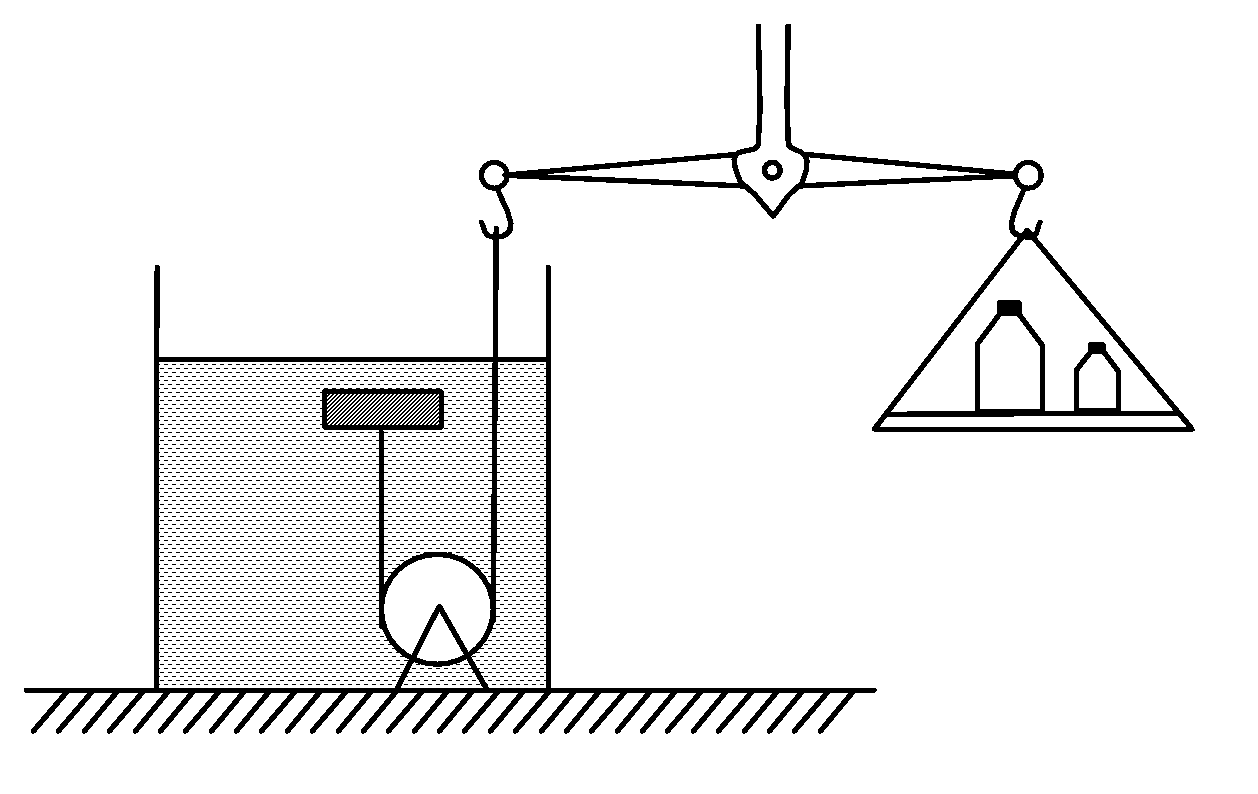
A diagram of this solution in given in Fig. A hook is set in the bottom of the vessel with a pulley attached; a thread is passed through the pulley and attached to the body at one end and the scales at the other. Then weights must be placed on the other scale-pan to achieve equilibrium; these weights will be equivalent to the up thrust, less the weight of the body.
Prepare Smarter with CGP Edu
Get practice questions, solutions, and test series in one place.
Write a Review
Share your experience with this question and solution.
Commentary
Send your comment, doubt, correction, or feedback to admin.
Similar Questions
Explore conceptually related problems