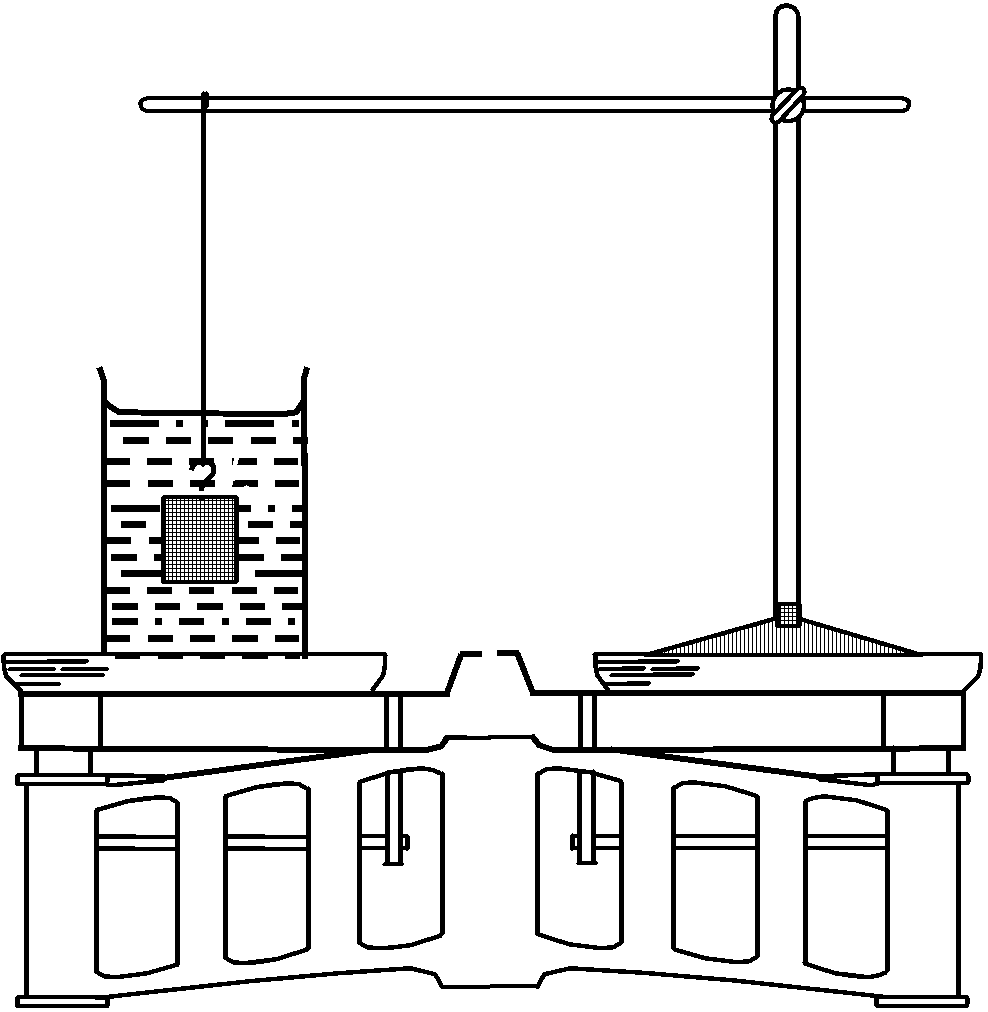
On one scale-pan of a pair of scales is a vessel containing water, and on the other is a stand, from the arm of which a body is suspended by a weightless thread (Fig.). While the body is not in the water, the scales are in equilibrium. Then the thread is lengthened so that the body is entirely immersed in the water. As a result, equilibrium is destroyed. What should be done to restore equilibrium?
Text Solution
Verified by ExpertsCHECK THE SOLUTION.
Sol. According to Archimedes' principle an upthrust is exerted by a liquid on a body immersed in the liquid, the upthrust being equal to the weight of liquid of the same volume as that occupied by the immersed body. This force reduces the tension in the thread from which the body is suspended. Therefore the following forces are acting on the right-hand scale-pan: the weight of the stand, and the weight of the body less the weight of the displaced water. According to Newton's third law, a body immersed in liquid equal to the upthrust, and this will be transmitted by way of the liquid in the vessel to the left-hand scale-pan. The additional force indicated comes into play because the level of water is raised by the immersion and consequently the pressure on the bottom of the vessel is increased. So the following forces will be acting on the left-hand scale-pan: the weight of the vessel and water, and the weight of a volume of water equal to the volume of the immersed body. Since the stand plus body weighs the same as the vessel plus water, equilibrium can be restored by placing on the scale-pan which supports the stand a load equal to twice the weight of a volume of water equal to the volume occupied by the body.
Prepare Smarter with CGP Edu
Get practice questions, solutions, and test series in one place.
Write a Review
Share your experience with this question and solution.
Commentary
Send your comment, doubt, correction, or feedback to admin.
Similar Questions
Explore conceptually related problems