Published by:
CGP EDU Academic Team
Published on: September 12, 2026
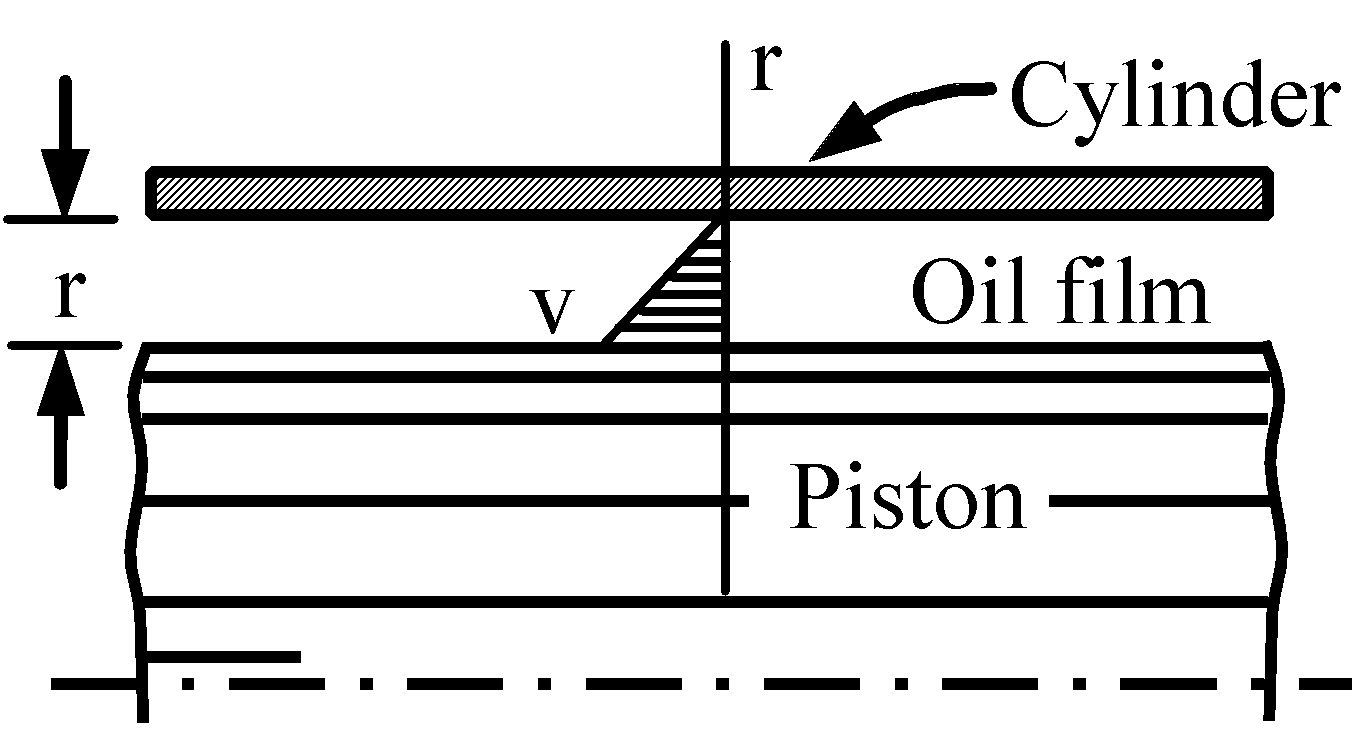
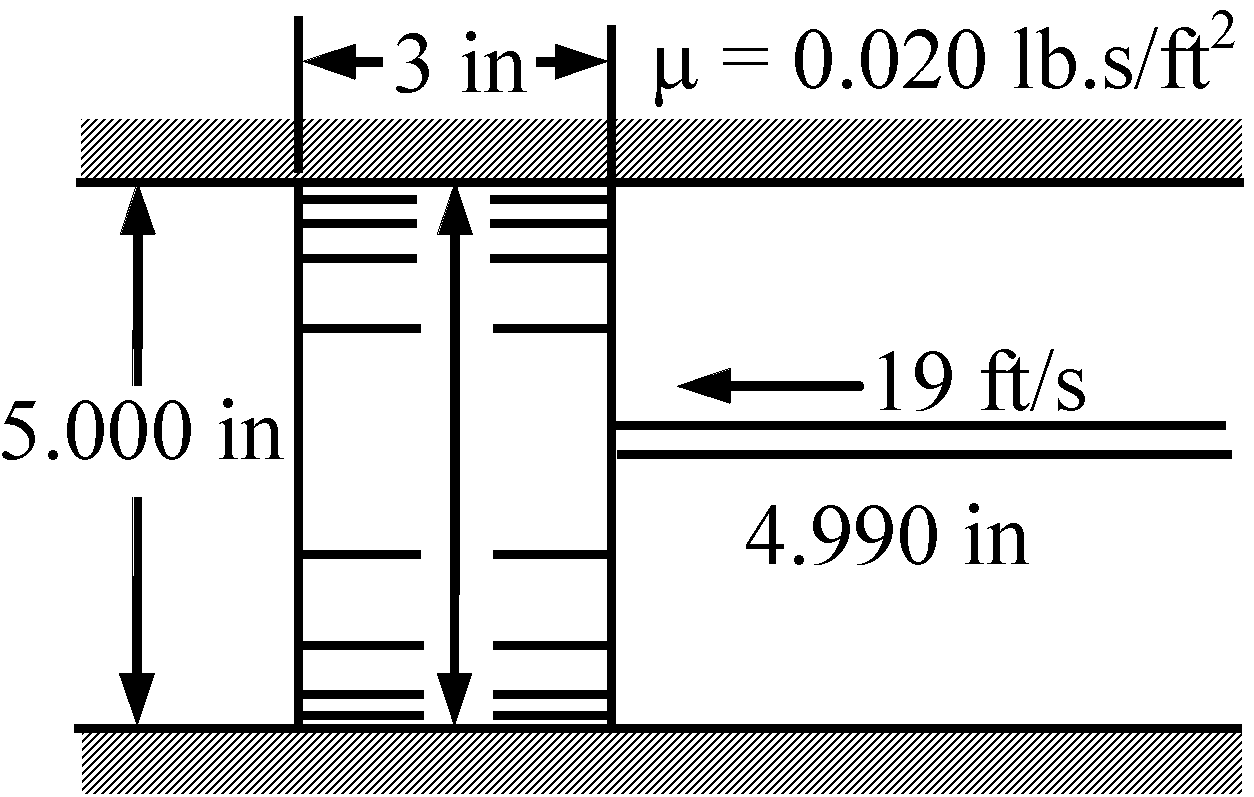
A piston is moving through a cylinder at a speed of 19 ft/s, as shown in Fig. The film of oil separating the piston from the cylinder has a viscosity of 0.020 lb.s/ft 2 . What is the force required to maintain this motion?
Text Solution
Verified by ExpertsThe correct answer is:
A
Step 1: Understand the problem
The piston is moving through a cylinder at a speed of 19 ft/s, with a film of oil that has a viscosity of 0.020 lb.s/ft2. We are to find the force required to maintain this motion.
Step 2: Identify the equation for viscous flow
The force required to maintain a constant velocity in a viscous fluid can be calculated using the formula:
F = μ * A * (V / d)
Where:
- F is the force (in lb)
- μ is the dynamic viscosity (in lb.s/ft2)
- A is the area of the piston (in ft2)
- V is the velocity (in ft/s)
- d is the thickness of the film (in ft)
Step 3: Gather the values
From the information provided:
- V = 19 ft/s
- μ = 0.020 lb.s/ft2
- The area A can be calculated from the diameter (if given) of the piston; let’s assume diameter = 3 in = 0.25 ft, hence the area:
A = π(d/2)2 = π(0.25/2)2 = π(0.125)2 = 0.0491 ft2
Step 4: Assume a thickness of the film
Assume d = 0.01 ft (10 mils = 0.01 ft) for the thickness of the oil film.
Step 5: Plug the values into the formula
Now substituting the values into F = μ * A * (V / d)
F = 0.020 * 0.0491 * (19 / 0.01) = 0.020 * 0.0491 * 1900 = 0.765 lb
Therefore, the force required to maintain this motion is approximately:
F ≈ 0.77 lb
Thus, the answer is (A) assuming it corresponds to this range.
The piston is moving through a cylinder at a speed of 19 ft/s, with a film of oil that has a viscosity of 0.020 lb.s/ft2. We are to find the force required to maintain this motion.
Step 2: Identify the equation for viscous flow
The force required to maintain a constant velocity in a viscous fluid can be calculated using the formula:
F = μ * A * (V / d)
Where:
- F is the force (in lb)
- μ is the dynamic viscosity (in lb.s/ft2)
- A is the area of the piston (in ft2)
- V is the velocity (in ft/s)
- d is the thickness of the film (in ft)
Step 3: Gather the values
From the information provided:
- V = 19 ft/s
- μ = 0.020 lb.s/ft2
- The area A can be calculated from the diameter (if given) of the piston; let’s assume diameter = 3 in = 0.25 ft, hence the area:
A = π(d/2)2 = π(0.25/2)2 = π(0.125)2 = 0.0491 ft2
Step 4: Assume a thickness of the film
Assume d = 0.01 ft (10 mils = 0.01 ft) for the thickness of the oil film.
Step 5: Plug the values into the formula
Now substituting the values into F = μ * A * (V / d)
F = 0.020 * 0.0491 * (19 / 0.01) = 0.020 * 0.0491 * 1900 = 0.765 lb
Therefore, the force required to maintain this motion is approximately:
F ≈ 0.77 lb
Thus, the answer is (A) assuming it corresponds to this range.
Prepare Smarter with CGP Edu
Get practice questions, solutions, and test series in one place.
Write a Review
Share your experience with this question and solution.
Commentary
Send your comment, doubt, correction, or feedback to admin.
Similar Questions
Explore conceptually related problems
A U-tube in which the cross-sectional area of the limb on the left is one quarter, the limb on the …
A wooden block, with a coin placed on its top, floats in water as shown in fig. the distance l and …
A body floats in a liquid contained in a beaker. The whole system as shown falls freely under gravi…
A liquid is kept in a cylindrical vessel which is being rotated about a vertical axis through the c…
Water is filled in a cylindrical container to a height of 3m. The ratio of the cross-sectional area…
A large open tank has two holes in the wall. One is a square hole of side L at a depth y from the t…