Published by:
CGP EDU Academic Team
Published on: September 12, 2026
A barometer made of a very narrow tube (see figure) is placed at normal temperature and pressure. The coefficient of volume expansion of mercury is 0.00018 per ºC and that of the tube is negligible. The temperature of mercury in the barometer is now raised by 1ºC, but the temperature of the atmosphere does not change. Then the mercury height in the tube remains unchanged.
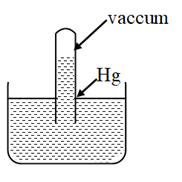
Text Solution
Verified by ExpertsThe correct answer is:
A
Step 1: Understand the scenario: The mercury expands when heated, leading to a change in volume. The expansion of the mercury can be expressed using the coefficient of volume expansion.
Step 2: Calculate the change in volume of mercury due to the temperature change. The formula for volume expansion is given by:
$$ \Delta V = V_0 \beta \Delta T $$
where:
$$ \Delta V $$ = change in volume,
$$ V_0 $$ = initial volume,
$$ \beta $$ = coefficient of volume expansion (0.00018 per ºC),
$$ \Delta T $$ = change in temperature (1ºC).
Step 3: The increase in volume will cause a rise in the height of the mercury column. However, since the barometer is in a vacuum, this rise is countered by the atmospheric pressure acting on the mercury surface.
Step 4: Since the tube is very narrow and the increase in mercury height is negligible due to the volume increase being completely balanced by atmospheric pressure, the height of mercury remains unchanged.
Therefore, A.
Step 2: Calculate the change in volume of mercury due to the temperature change. The formula for volume expansion is given by:
$$ \Delta V = V_0 \beta \Delta T $$
where:
$$ \Delta V $$ = change in volume,
$$ V_0 $$ = initial volume,
$$ \beta $$ = coefficient of volume expansion (0.00018 per ºC),
$$ \Delta T $$ = change in temperature (1ºC).
Step 3: The increase in volume will cause a rise in the height of the mercury column. However, since the barometer is in a vacuum, this rise is countered by the atmospheric pressure acting on the mercury surface.
Step 4: Since the tube is very narrow and the increase in mercury height is negligible due to the volume increase being completely balanced by atmospheric pressure, the height of mercury remains unchanged.
Therefore, A.
Prepare Smarter with CGP Edu
Get practice questions, solutions, and test series in one place.
Write a Review
Share your experience with this question and solution.
Commentary
Send your comment, doubt, correction, or feedback to admin.
Similar Questions
Explore conceptually related problems
A U-tube in which the cross-sectional area of the limb on the left is one quarter, the limb on the …
A wooden block, with a coin placed on its top, floats in water as shown in fig. the distance l and …
A body floats in a liquid contained in a beaker. The whole system as shown falls freely under gravi…
A liquid is kept in a cylindrical vessel which is being rotated about a vertical axis through the c…
Water is filled in a cylindrical container to a height of 3m. The ratio of the cross-sectional area…
A large open tank has two holes in the wall. One is a square hole of side L at a depth y from the t…