Mercury is the only metallic element that is normally liquid at room temperature. It possesses the properties usually associated with metals, such as high electrical and thermal conductivity. Since it remains liquid over a wide range of temperatures, it can be put to many practical uses. Thermometers, manometers, and sealed electrical switches and relays all commonly utilize mercury. Table 1 compares some of the properties of mercury with those of water and iron.
Freezing Point (C) | Boiling Point (C) | Density (g/cm3) | Specific heat (J/kgK) | |
Mercury | -38.87 | 357 | 13.6 | 138 |
Water | 0.0 | 100 | 1.00 | 4190 |
Iron | 1535 | 3000 | 7.8 | 470 |


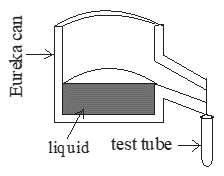
An experiment is performed to measure the relative densities of water and mercury. An iron cube with sides 2 cm long is lowered into a “Eureka Can,” shown in the figure below, that has been filled with water to the level of the bottom of the spout. A test tube labelled W is used to collect the displaced water. This procedure is now repeated a second time, using mercury instead of water, and the displaced mercury is collected in a test tube labelled M.
(i) A 10 cm3 sample of water is collected and heated at a constant rate. The following graph shows the temperature as a function of time.

If 10 cm3 of mercury were heated at the same rate, which of the following graphs might represent the results? (Note: The energy, Q, required to raise the temperature by Δ T is given by Q = mc Δ T, where m is the mass and c is the specific heat)
Text Solution
Verified by ExpertsCHECK THE SOLUTION.
Ans.
(i)
Sol.

(ii)
Sol. (C H ) w > (C H ) Fe > (C H ) Hg
(iii)
Sol. ( Δ T) Hg > ( Δ T) Fe > ( Δ T) w
Prepare Smarter with CGP Edu
Get practice questions, solutions, and test series in one place.
Write a Review
Share your experience with this question and solution.
Commentary
Send your comment, doubt, correction, or feedback to admin.
Similar Questions
Explore conceptually related problems