Published by:
CGP EDU Academic Team
Published on: September 12, 2026
A piston moves upward a distance of 5 cm while 200 J of heat is added (Fig.). Calculate the change in internal energy of the vapour if the spring is originally unstretched.
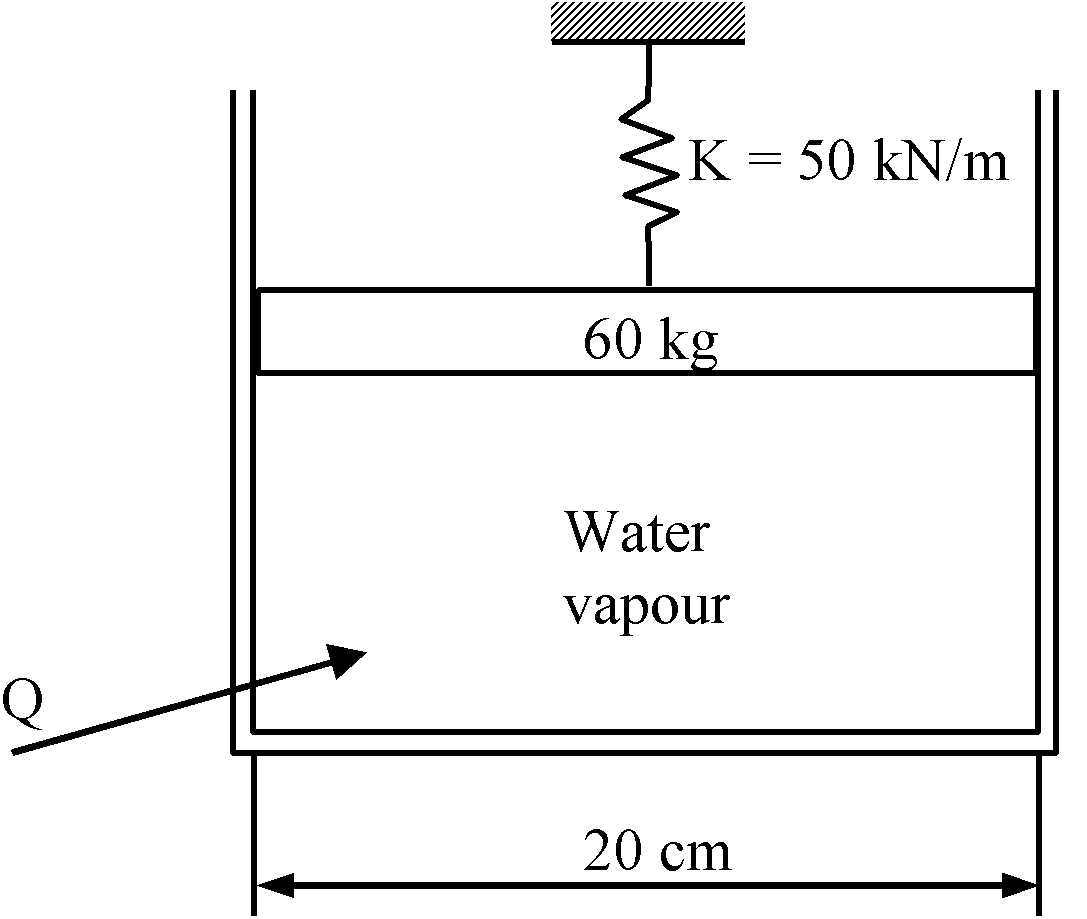
Text Solution
Verified by ExpertsThe correct answer is:
A
Step 1: Identify the given values:
Heat added (Q) = 200 J
Distance moved by the piston (d) = 5 cm = 0.05 m
Spring constant (K) = 50 kN/m = 50000 N/m
Mass (m) = 60 kg.
Step 2: Calculate the force acting on the piston due to the weight:
F = m * g = 60 kg * 9.81 m/s² = 588.6 N.
Step 3: The work done against the spring when the piston moves up is given by:
Work done (W) = \frac{1}{2} Kx^2, where x = displacement of the spring. Since the piston moves 5 cm upward, the spring will also compress or stretch a small distance 'x'. Therefore, we can assume x to be equal to the piston movement.
\( W = \frac{1}{2} * 50000 N/m * (0.05 m)^2 = \frac{1}{2} * 50000 * 0.0025 = 62.5 J. \)
Step 4: Using the First Law of Thermodynamics:
\( \Delta U = Q - W \)
Where: \( \Delta U \) = change in internal energy, Q = heat added, W = work done.
Substituting the values, we get: \( \Delta U = 200 J - 62.5 J = 137.5 J. \)
Therefore, the change in internal energy of the vapor is 137.5 J.
Therefore, the answer is 137.5 J.
Heat added (Q) = 200 J
Distance moved by the piston (d) = 5 cm = 0.05 m
Spring constant (K) = 50 kN/m = 50000 N/m
Mass (m) = 60 kg.
Step 2: Calculate the force acting on the piston due to the weight:
F = m * g = 60 kg * 9.81 m/s² = 588.6 N.
Step 3: The work done against the spring when the piston moves up is given by:
Work done (W) = \frac{1}{2} Kx^2, where x = displacement of the spring. Since the piston moves 5 cm upward, the spring will also compress or stretch a small distance 'x'. Therefore, we can assume x to be equal to the piston movement.
\( W = \frac{1}{2} * 50000 N/m * (0.05 m)^2 = \frac{1}{2} * 50000 * 0.0025 = 62.5 J. \)
Step 4: Using the First Law of Thermodynamics:
\( \Delta U = Q - W \)
Where: \( \Delta U \) = change in internal energy, Q = heat added, W = work done.
Substituting the values, we get: \( \Delta U = 200 J - 62.5 J = 137.5 J. \)
Therefore, the change in internal energy of the vapor is 137.5 J.
Therefore, the answer is 137.5 J.
Prepare Smarter with CGP Edu
Get practice questions, solutions, and test series in one place.
Write a Review
Share your experience with this question and solution.
Commentary
Send your comment, doubt, correction, or feedback to admin.
Similar Questions
Explore conceptually related problems
The internal energy of an ideal gas depends upon
In changing the state of thermodynamics from A to B state, the heat required is Q and the work done…
Heat given to a system is 35 joules and work done by the system is 15 joules. The change in the int…
The temperature of an ideal gas is kept constant as it expands. The gas does external work. During …
The first law of thermodynamics is concerned with the conservation of
A thermodynamic system goes from states
(i) , V to , V
(ii) P, V to P, 2V.
Then work done in the …