Published by:
CGP EDU Academic Team
Published on: September 12, 2026
In an experiment on the specific heat of a metal, a 0.20 kg block of the metal at 150ºC is dropped in a copper calorimeter (of water equivalent 0.025 kg) containing 150 cm3 of water at 27ºC. The final temperature is 40ºC. Compute the specific heat of the metal.
Text Solution
Verified by ExpertsThe correct answer is:
A
Step 1: Understand the situation
We have a block of metal at a high temperature (150ºC) and a calorimeter with water at a lower temperature (27ºC). When the metal block is dropped into the water, it will lose heat, while the water and calorimeter will gain heat until they reach a common final temperature (40ºC).
Step 2: Apply the principle of conservation of energy
The heat lost by the metal block will equal the heat gained by the water and the calorimeter. This can be expressed mathematically as:
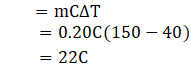
$$m_{metal} c_{metal} (T_{initial, metal} - T_{final}) = (m_{water} + m_{cal}) c_{water} (T_{final} - T_{initial, water})$$
Where:
Step 3: Substitute values and solve
Now, plug the values into the equation:
$$0.20 imes c_{metal} imes (150 - 40) = (0.15 + 0.025) imes 4184 imes (40 - 27)$$
Now simplifying, we get:
$$0.20 imes c_{metal} imes 110 = 0.175 imes 4184 imes 13$$
Calculate the right side:
$$0.175 imes 4184 imes 13 = 0.175 imes 54412 = 9503.1$$
Thus, we have:
$$0.20 imes c_{metal} imes 110 = 9503.1$$
Divide both sides by (0.20 * 110):
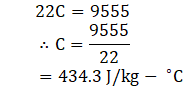
$$c_{metal} = \frac{9503.1}{0.20 imes 110}$$
Calculating this gives:
$$c_{metal} = \frac{9503.1}{22} = 432.4 \text{ J/(kg·ºC)}$$
Final Result:
The specific heat of the metal is approximately 432.4 J/(kg·ºC). Therefore, option A is the correct answer.
We have a block of metal at a high temperature (150ºC) and a calorimeter with water at a lower temperature (27ºC). When the metal block is dropped into the water, it will lose heat, while the water and calorimeter will gain heat until they reach a common final temperature (40ºC).
Step 2: Apply the principle of conservation of energy
The heat lost by the metal block will equal the heat gained by the water and the calorimeter. This can be expressed mathematically as:
$$m_{metal} c_{metal} (T_{initial, metal} - T_{final}) = (m_{water} + m_{cal}) c_{water} (T_{final} - T_{initial, water})$$
Where:
- $m_{metal}$ = mass of the metal = 0.20 kg
- $c_{metal}$ = specific heat of the metal (what we are trying to find)
- $T_{initial, metal}$ = initial temperature of the metal = 150ºC
- $T_{final}$ = final temperature = 40ºC
- $m_{water}$ = mass of water = volume × density = 150 cm³ × 1 g/cm³ = 0.15 kg
- $m_{cal}$ = water equivalent of the calorimeter = 0.025 kg
- $c_{water}$ = specific heat of water = 4184 J/(kg·ºC)
Step 3: Substitute values and solve
Now, plug the values into the equation:
$$0.20 imes c_{metal} imes (150 - 40) = (0.15 + 0.025) imes 4184 imes (40 - 27)$$
Now simplifying, we get:
$$0.20 imes c_{metal} imes 110 = 0.175 imes 4184 imes 13$$
Calculate the right side:
$$0.175 imes 4184 imes 13 = 0.175 imes 54412 = 9503.1$$
Thus, we have:
$$0.20 imes c_{metal} imes 110 = 9503.1$$
Divide both sides by (0.20 * 110):
$$c_{metal} = \frac{9503.1}{0.20 imes 110}$$
Calculating this gives:
$$c_{metal} = \frac{9503.1}{22} = 432.4 \text{ J/(kg·ºC)}$$
Final Result:
The specific heat of the metal is approximately 432.4 J/(kg·ºC). Therefore, option A is the correct answer.
Prepare Smarter with CGP Edu
Get practice questions, solutions, and test series in one place.
Write a Review
Share your experience with this question and solution.
Commentary
Send your comment, doubt, correction, or feedback to admin.
Similar Questions
Explore conceptually related problems
An ideal gas having molar specific heat capacity at constant volume is R, the molar specific heat …
Mayer’s formula for the relation between two principal specific heats C P and C V of a gas is given…
For a gas of molecular weight M specific heat capacity at constant pressure is
One mole of an ideal monoatomic gas at temperature expands slowly according to the law constant. …
The specific heat of air at constant volume is 0.172 Cal g –1 °C –1 . The change in internal energy…
A geyser heats water flowing at the rate of 4 liter per minute from 30°C to 80°C. If the geyser ope…