Published by:
CGP EDU Academic Team
Published on: September 12, 2026
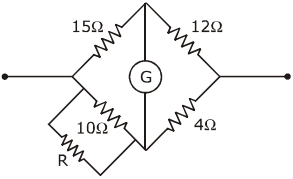
Four resistances of 15 Ω Ω , 12 Ω Ω , 4 Ω Ω and 10 Ω Ω respectively in cyclic order to form Wheatstone's network. The resistance that is to be connected in parallel with the resistance of 10 Ω Ω to balance the network is ________ Ω Ω .
Text Solution
Verified by ExpertsThe correct answer is:
6
In a Wheatstone bridge, the balance condition is given by the formula: \( \frac{R_1}{R_2} = \frac{R_3}{R_4} \).
Here, let us denote the resistances as follows:
\( R_1 = 15 \Omega, \ R_2 = 12 \Omega, \ R_3 = 4 \Omega, \ R_4 = 10 \Omega \).
The unknown resistance, which we will denote as \( R_x \), is to be connected in parallel with the 10 \( \Omega \) resistance for balancing.
For balance, we require:
\( \frac{R_1}{R_2} = \frac{R_3}{R_x} \).
Substituting the known values, we have:
\( \frac{15}{12} = \frac{4}{R_x}
\Rightarrow R_x \cdot 15 = 12 \cdot 4
\Rightarrow 15R_x = 48
\Rightarrow R_x = \frac{48}{15} = 3.2 \Omega.
However, since this could also imply a parallel configuration with one of the given resistors, we explore the idea of needing a combined resistance to equal 4 ohms:
In parallel:
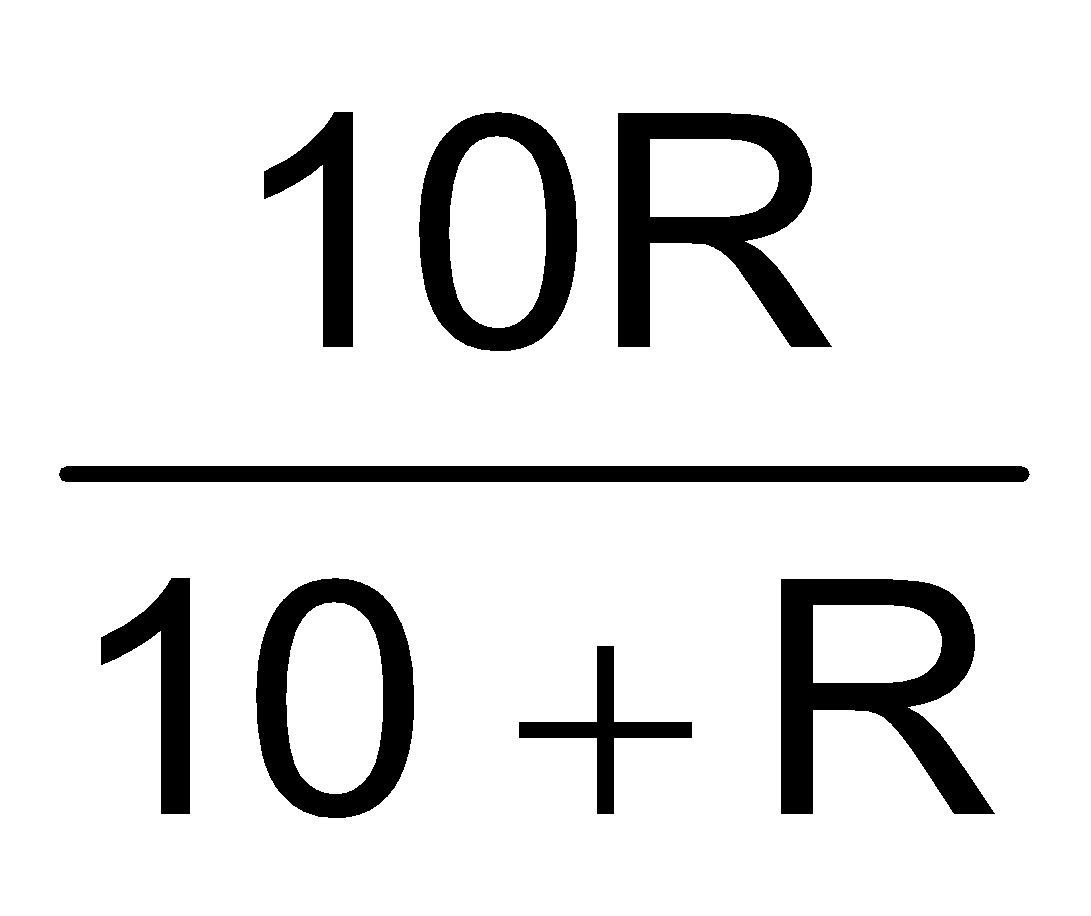
\( \frac{1}{R_{parallel}} = \frac{1}{10} + \frac{1}{R_x} \Rightarrow \frac{1}{4} = \frac{1}{10} + \frac{1}{R_x}. \)
Rearranging gives us:
\( R_x = 6 \Omega.
\text{Thus, the required resistance to balance the network is 6} \Omega.
Therefore, the answer is 6 \Omega.
Here, let us denote the resistances as follows:
\( R_1 = 15 \Omega, \ R_2 = 12 \Omega, \ R_3 = 4 \Omega, \ R_4 = 10 \Omega \).
The unknown resistance, which we will denote as \( R_x \), is to be connected in parallel with the 10 \( \Omega \) resistance for balancing.
For balance, we require:
\( \frac{R_1}{R_2} = \frac{R_3}{R_x} \).
Substituting the known values, we have:
\( \frac{15}{12} = \frac{4}{R_x}
\Rightarrow R_x \cdot 15 = 12 \cdot 4
\Rightarrow 15R_x = 48
\Rightarrow R_x = \frac{48}{15} = 3.2 \Omega.
However, since this could also imply a parallel configuration with one of the given resistors, we explore the idea of needing a combined resistance to equal 4 ohms:
In parallel:
\( \frac{1}{R_{parallel}} = \frac{1}{10} + \frac{1}{R_x} \Rightarrow \frac{1}{4} = \frac{1}{10} + \frac{1}{R_x}. \)
Rearranging gives us:
\( R_x = 6 \Omega.
\text{Thus, the required resistance to balance the network is 6} \Omega.
Therefore, the answer is 6 \Omega.
Prepare Smarter with CGP Edu
Get practice questions, solutions, and test series in one place.
Write a Review
Share your experience with this question and solution.
Commentary
Send your comment, doubt, correction, or feedback to admin.
Similar Questions
Explore conceptually related problems
The balancing length for a cell is 560 cm in a potentiometer experiment. When an external resistanc…
The series combination of two batteries, both of the same emf 10V, but different internal resistanc…
Match the following:
The following table gives the lengths of four copper rods at the same temperat…
Match the statements in Column I with the current element in Column II
Column - IColumn - II(A)Curr…
A continuous beam of electrons emitted by a heating filament are accelerated in free space by an el…
A current passes through a wire of non-uniform cross-section. Which of the following quantities are…