The index of refraction of glass can be increased by diffusing in impurities. It is then possible to make a lens of constant thickness. Given a disk of radius a and thickness d , find the radial variation of the index of refraction n(r) which will produce a lens with focal length F. You may assume a thin lens (d << a).




Text Solution
Verified by ExpertsC
Let the refractive index of the material of the disk be n and the radial distribution of the refractive index of the impurity-diffused disk be represented by n(r), with n(0) = n 0 .
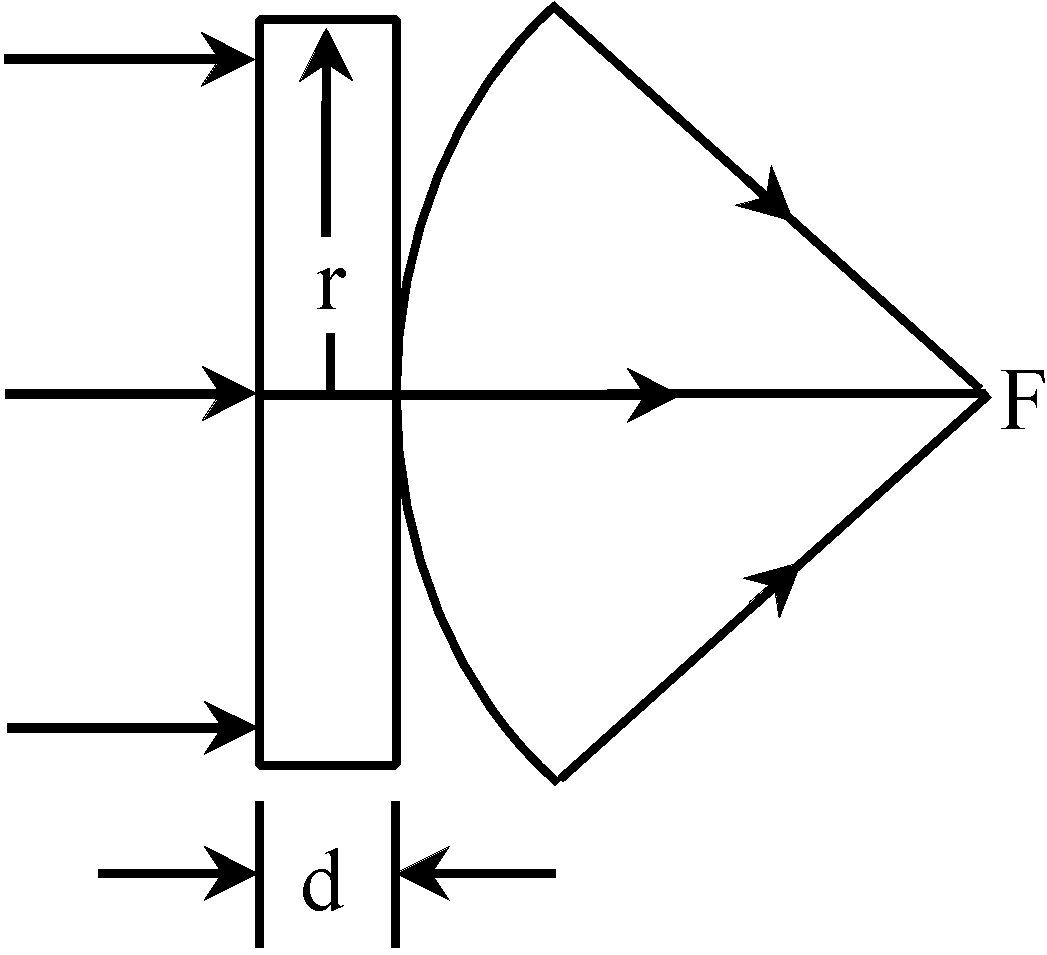
Fig.
Incident plane waves entering the lens refract and converge at the focus F as shown in Fig. We have
[n(r) – n 0 ]d = –  + F,
+ F,
i.e., n(r) = n 0 –  .
.
For F >> r, we obtain
n(r) = n 0 –  .
.
Prepare Smarter with CGP Edu
Get practice questions, solutions, and test series in one place.
Write a Review
Share your experience with this question and solution.
Commentary
Send your comment, doubt, correction, or feedback to admin.
Similar Questions
Explore conceptually related problems