A prism (triangular) is an optical device which is used to deviate or disperse light passing through it. Any of the two adjacent surfaces can be used for refracting the light ray and angle between them is termed as refracting angle or angle of prism. Angle of deviation depends on angle of incidence of light ray. For minimum deviation angle of incidence is equal to angle of emergence.
(i) Consider a prism made of material of RI  and prism angle 91º. The angle at which light incident at first refracting surface will not emerge at second refracting surface is :
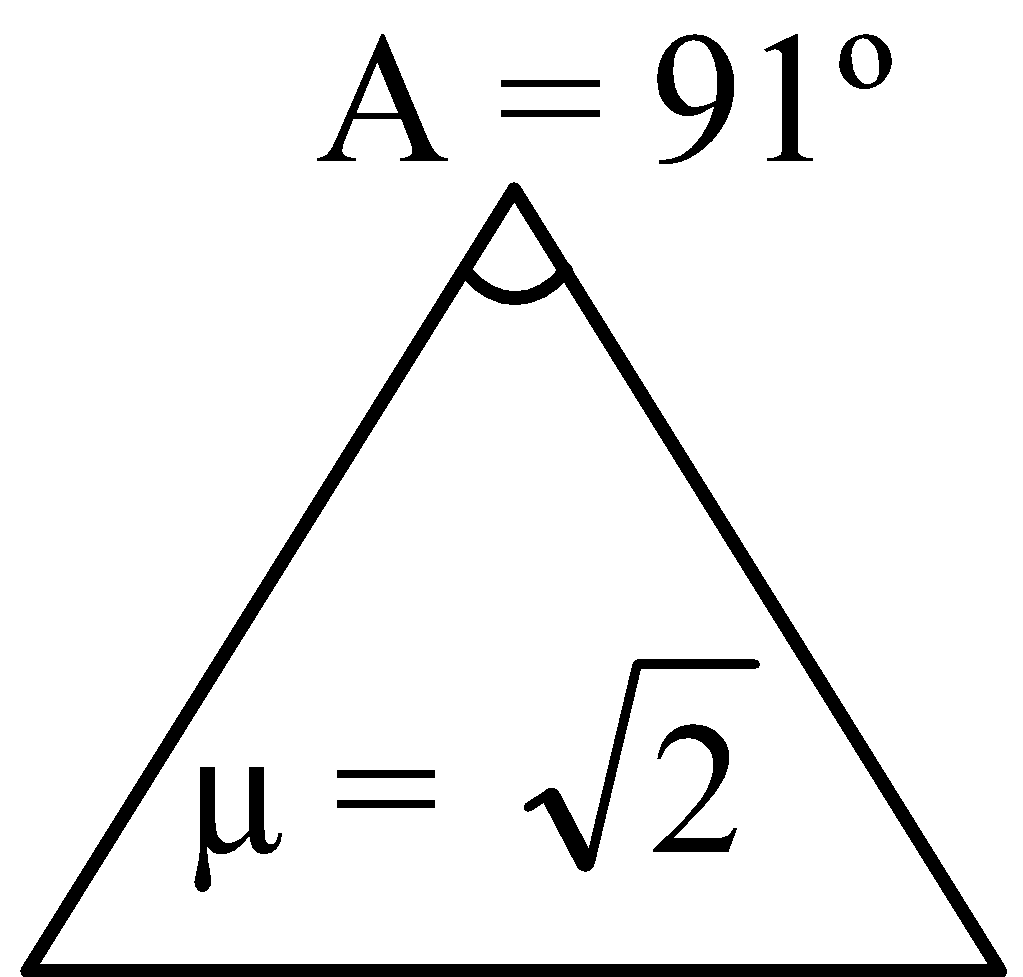
Text Solution
Verified by ExpertsCHECK THE SOLUTION.
Ans.
(i)
Sol. No light ray will emerge if A > 2i c
(ii)
Sol. i + e – A = δ
or A = i + e – δ
= 20 + 70 – 45º = 45º
(iii)
Sol.

Light ray will emerge only if
60º < i c
sin60º < sin i c
or µ < 
Prepare Smarter with CGP Edu
Get practice questions, solutions, and test series in one place.
Write a Review
Share your experience with this question and solution.
Commentary
Send your comment, doubt, correction, or feedback to admin.
Similar Questions
Explore conceptually related problems