A prism 'X' and another 'Y' are kept in contact with their refracting angles placed opposite to each other as shown in figure. White light is incident on the combination from the left. Column-I describes some situations. Match Column-I with the possible outcomes given in Column-II.
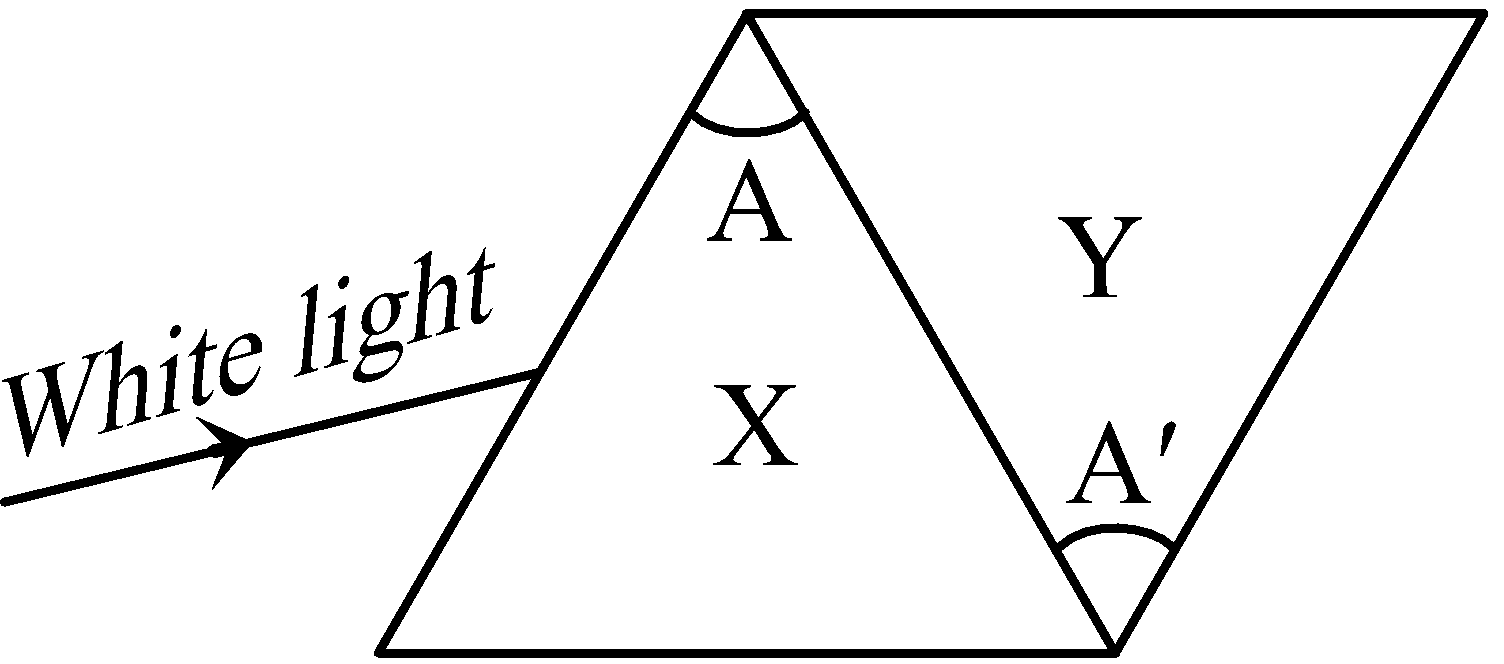
Column-I | Column-II |
(i) The prisms are made of same without material and their Refractingangles are equal i.e., A = A′.The combination will cause | [A] Dispersion deviation |
(ii) The prisms are made of same material and their refracting angles are not equal, i.e., A ≠ A′. The combination will cause | [B] No deviation |
(iii) The prisms are made of different materials and their refracting angles are equal, i.e., A = A′. Also the quantity μV – μR has different values for the two prisms. Here μV and μR are the refractive indices for violet and red colours. The combination will cause | [C] No dispersion |
(iv) The prisms are made of different material and their refracting angles are unequal, i.e., A ≠ A′. Also = –, where μ is the refractive index for the mean wavelength (yellow) for the prism wavelength (yellow) for the prism X while μ′ is the corresponding value for prism Y. The combination will cause | [D] Both deviation and dispersion |


Text Solution
Verified by ExpertsCHECK THE SOLUTION.
Ans.
(i) [B], [C]
(ii) [D]
(iii) [D]
(iv) [A], [B]
Sol. (i) No deviation, No dispersion
(ii) Both deviation and dispersion
(iii) Both deviation and dispersion
(iv) Dispersion deviation, No deviation
Prepare Smarter with CGP Edu
Get practice questions, solutions, and test series in one place.
Write a Review
Share your experience with this question and solution.
Commentary
Send your comment, doubt, correction, or feedback to admin.
Similar Questions
Explore conceptually related problems