Home Physics Ray Optics Mix Two spherical mirror, one convex and the oth…
Physics Ray Optics Mix Subjective Type
Published on: September 12, 2026

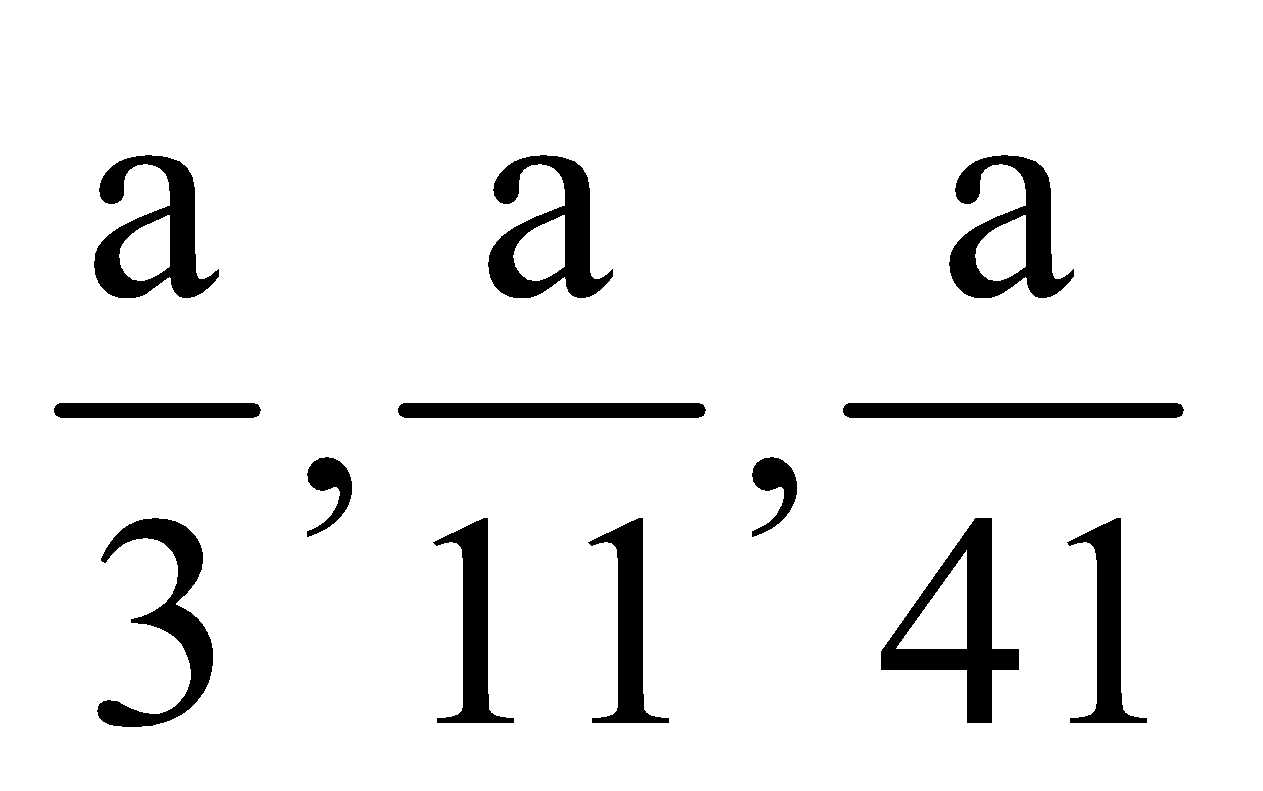
Two spherical mirror, one convex and the other concave, each of same radius of curvature R are arranged coaxially at a distance of 2R from each other as shown in figure. A small circle of radius a is drawn on the convex mirror. What is the radii of first three images of the circle?

Share this question

For Instagram sharing, use “Apps” on mobile or copy the link.

Text Solution

Verified by Experts
The correct answer is:
A
Step 1: For a convex mirror, the focal length (f) is given by $f = \frac{R}{2}$, where R is the radius of curvature.
Therefore, $f = \frac{R}{2}$.
Step 2: For the small circle of radius a placed in front of the convex mirror at a distance equal to the center of curvature (R), the image distance (v1) can be calculated using the mirror formula:
$\frac{1}{f} = \frac{1}{u} + \frac{1}{v}$ where u = -R (object distance).
Therefore, $\frac{1}{\frac{R}{2}} = \frac{1}{-R} + \frac{1}{v_1}$.
Simplifying gives us $v_1 = \frac{R}{3}$ (virtual image).
Step 3: The magnification (M) for a spherical mirror is given by $M = -\frac{v}{u}$.
Therefore, $M_1 = -\frac{(R/3)}{-R} = \frac{1}{3}$.
The image radius (r1) due to the first image will be $r_1 = a \cdot M_1 = a \cdot \frac{1}{3}$.
Step 4: Now, this first image acts as an object for the concave mirror at a distance of 2R - (R/3) = (6R/3) - (R/3) = (5R/3). Apply the same mirror formula for the concave mirror:
Using $u = -\frac{5R}{3}$, we calculate $v_2$ using the formula. After simplification, it gives $v_2 = \frac{5R}{6}$. Thus, the second image radius (r2) can be calculated as
$r_2 = a \cdot M_2 = a \cdot \frac{5}{6}$.
Step 5: The second image again acts as an object for the convex mirror, and following the same process, we find the distance becomes (8R/6) and thus we find the third image so that
$r_3 = a \cdot M_3 = a \cdot \frac{27}{32}$.
The final resultant image sizes are $r_1, r_2, r_3$.
Therefore, the ratio of image radii corresponding to the first three images will be \{\frac{1}{3}, \frac{5}{6}, \frac{27}{32}\}.
Therefore, the answer is A.

Prepare Smarter with CGP Edu

Get practice questions, solutions, and test series in one place.

Write a Review

Share your experience with this question and solution.

Commentary

Send your comment, doubt, correction, or feedback to admin.

Student Reviews

What students say about this solution

No reviews yet. Be the first to write a review.

Similar Questions

Explore conceptually related problems

CG
CGP Question Assistant Question Bank + AI Help
Hi! Type your question or upload one screenshot. First I will search related questions from CGP Edu Question Bank. If none match, type YES and I will solve it with AI.
Upload only one screenshot at a time. Flow: Question Bank first → If not matched, type YES for AI solution.