A narrow beam of light S is incident on a dihedral angle α = 60º formed by identical flat mirrors OM and ON secured on axis O (Fig.). After being reflected from the mirrors, the light is focused by lens L and gets into stationary receiver R. The mirrors rotate with a constant angular velocity.
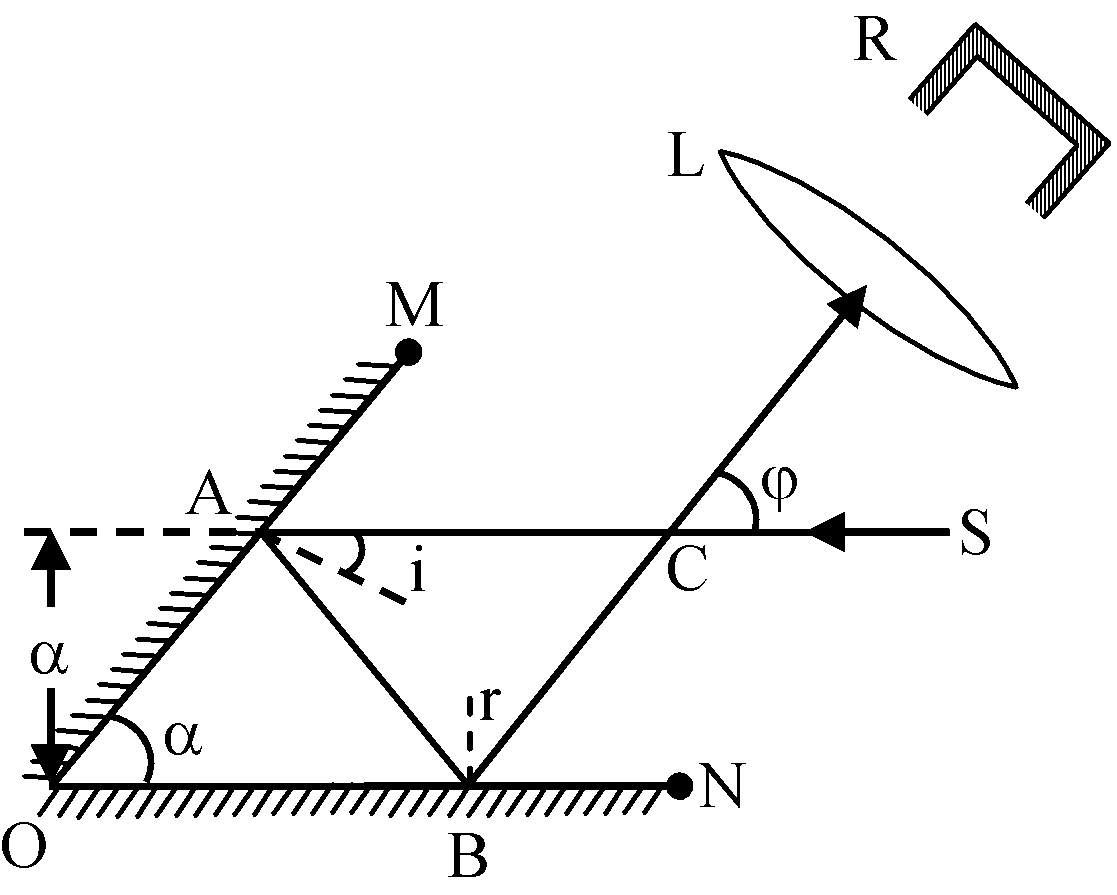
Fig.
Text Solution
Verified by ExpertsCHECK THE SOLUTION.
Sol. The beam reflected from mirror ON forms with the incident beam an angle ϕ (see Fig. a) that does not depend on the angle of incidence i . Indeed, as can be seen from triangle ABC, we have ϕ = 180º – 2 (i + r). On the other hand, in triangle OAB, we have α + (90º – i) + (90º – r) = 180º. Hence, ϕ = 180º – 2 α = 60º. When the mirror rotates, the direction of the reflected beam does not change.
Thus if the beam that fell on mirror OM is reflected from mirror ON, it will always get into the receiver

Fig.
As can easily be seen in Fig. showing two extreme positions of the mirrors at which the beam gets into the receiver (OM, ON and OM', ON'), this occurs during one-sixth of a revolution. For this reason one-sixth of all the energy of the beam will get into the receiver during one revolution, which is a sufficiently large interval of time.
Prepare Smarter with CGP Edu
Get practice questions, solutions, and test series in one place.
Write a Review
Share your experience with this question and solution.
Commentary
Send your comment, doubt, correction, or feedback to admin.
Similar Questions
Explore conceptually related problems