A man standing symmetrically infront of a plane mirror with beveled edges can see three images of his eyes when he is 3ft from the mirror [see Fig.
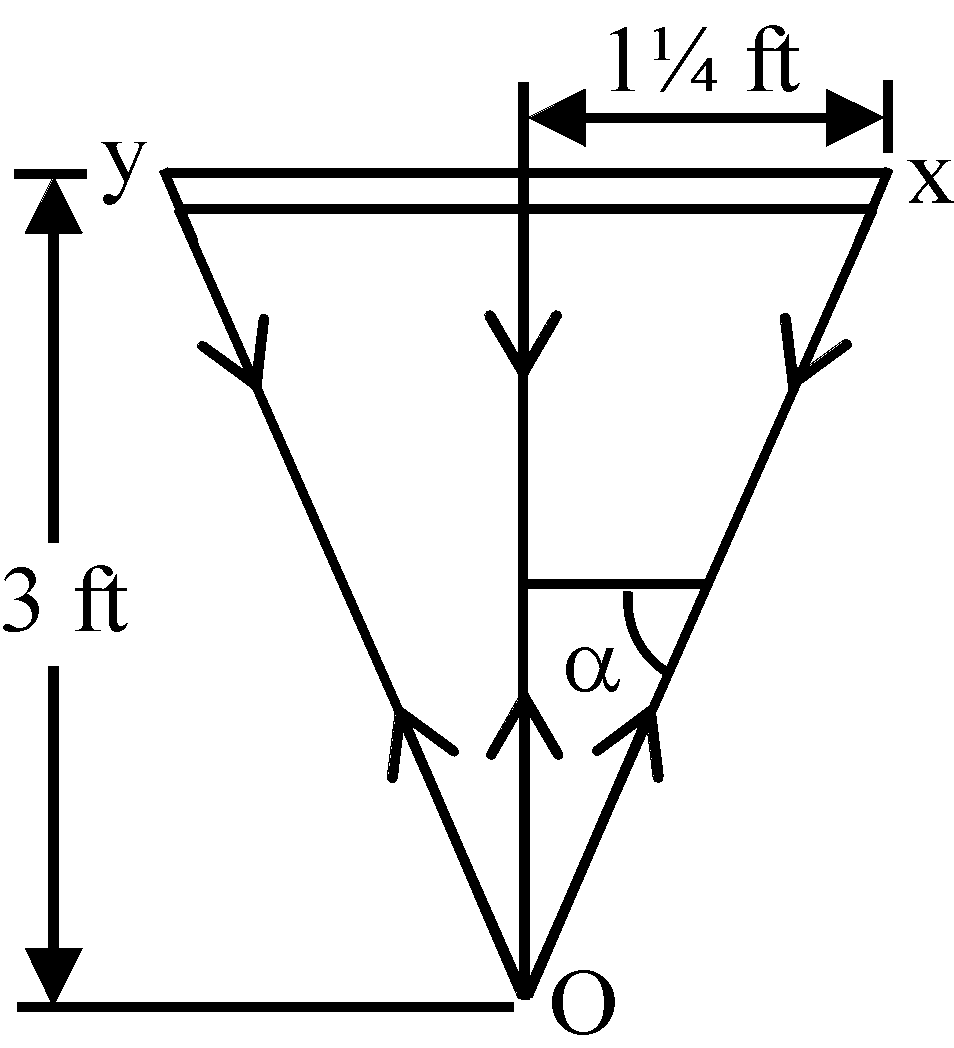 Fig.
Fig.
Text Solution
Verified by ExpertsCHECK THE SOLUTION.
Sol. The man can only see an image of his eyes if light leaves them, strikes the mirror, and is reflected back along the same path. The central image is thus formed by light traversing the perpendicular from his eyes to the mirror. The outer images are formed by light striking the beveled edges at the point A [see Fig. ] at an angle of incidence φ such that the angle of refraction φ ' makes the refracted ray strike the silvered surface normally. This must be the case if the ray of light is to leave the beveled edge by the same path with which it arrived. The angle φ ' lies between the normal to the bevelled edge and the normal to the back surface. Since ∠ SAX = 90º [see Fig. ].

Fig.
φ ' + ∠ DAX = 90º
But ∠ DAX = 90º – θ
Hence φ ' = 90º – 90º + θ = θ
Draw BA, a construction line at A parallel to the back of the mirror. Angle BAC is also equal to θ .
But by Snell's law, n 1 sin φ = n sin φ ', where n 1 is the refractive index of air (n 1 = 1) and n is that of glass. Then sin φ = n sin φ ' = n sin θ . Also α = θ + (90º – φ ) [see Fig. ].
sin [90º – ( α – θ )] = n sin θ .
But sin (90º – ψ ) = cos ψ
and cos ( α – θ ) = n sin θ .
By the trigonometric relation for double angles,
cos α cos θ + sin α sin θ = n sin θ
cos α + sin α tan θ = n tan θ
cos α = tan θ [n – sin α ]
tan θ = 
Looking at Fig. ,
cos α =  =
= 
sin α =  =
= 
whence tan θ =  = 0.625
Prepare Smarter with CGP Edu
Get practice questions, solutions, and test series in one place.
Write a Review
Share your experience with this question and solution.
Commentary
Send your comment, doubt, correction, or feedback to admin.
Similar Questions
Explore conceptually related problems