Published by:
CGP EDU Academic Team
Published on: September 12, 2026
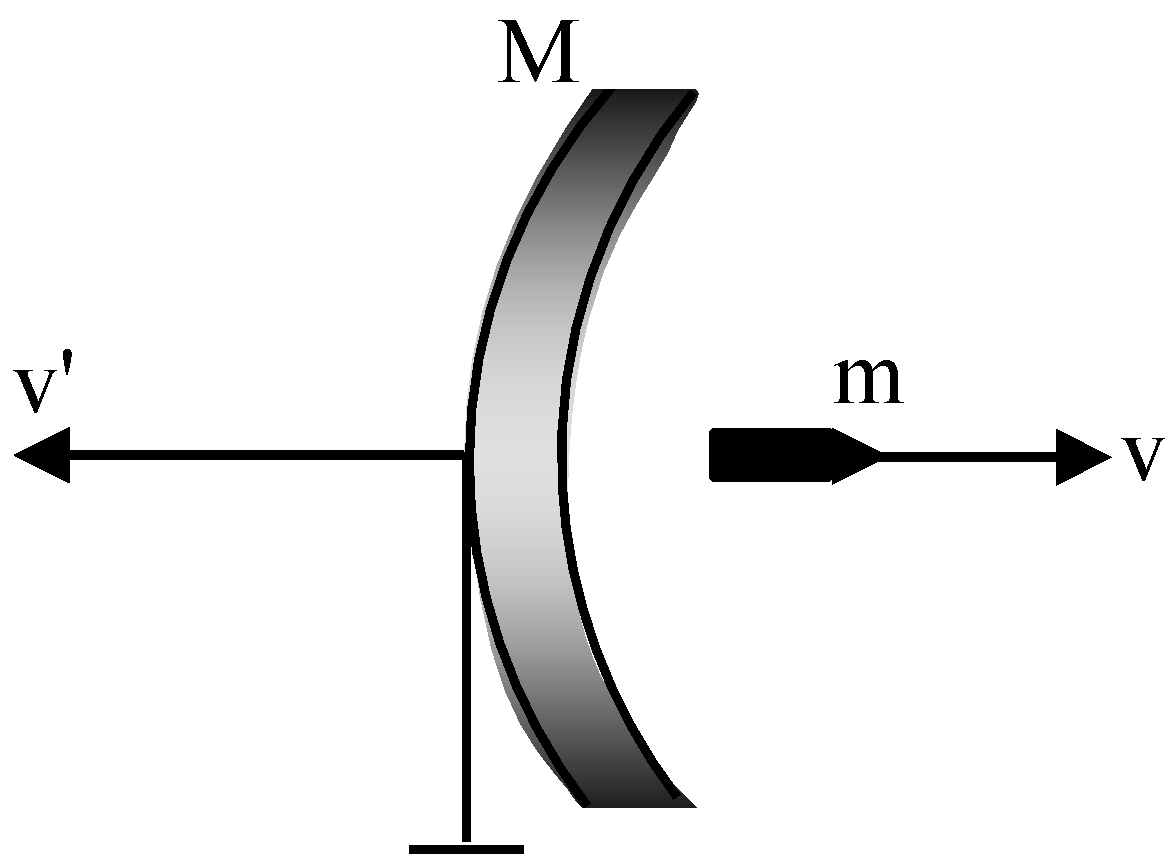
A gun of mass M fires a bullet of mass m with a horizontal speed V. The gun is fitted with a concave mirror of focal length f facing towards the receding bullet. Find the speed of separation of the bullet and the image just after the gun was fired.
Text Solution
Verified by ExpertsThe correct answer is:
A
Step 1: When the bullet of mass m is fired with speed V, it creates a backward motion of the gun (mass M) due to conservation of momentum. The speed of the gun is given by \( V_g = -\frac{mV}{M} \).
Step 2: The position of the image formed by the concave mirror will appear to be behind the mirror due to its concave nature. The mirror's focal length f determines the location of the image based on the mirror formula: \( \frac{1}{f} = \frac{1}{u} + \frac{1}{v} \), where u is the object distance (which will be negative for the bullet) and v is the image distance (positive).
Step 3: The velocity of the image formed by the mirror will match the speed of the bullet as it changes in time, considering the image is formed in line with the bullet.
Step 4: The speed of separation of the bullet and the image takes into account their velocities moving apart:
\( v_{separation} = V - (-V_g) = V + \frac{mV}{M} = V \left(1 + \frac{m}{M}\right) \).
Therefore, the speed of separation of the bullet and the image just after the gun was fired is \( V \left(1 + \frac{m}{M}\right) \). Thus, the correct answer reflects the motion dynamics after the shot.
Step 2: The position of the image formed by the concave mirror will appear to be behind the mirror due to its concave nature. The mirror's focal length f determines the location of the image based on the mirror formula: \( \frac{1}{f} = \frac{1}{u} + \frac{1}{v} \), where u is the object distance (which will be negative for the bullet) and v is the image distance (positive).
Step 3: The velocity of the image formed by the mirror will match the speed of the bullet as it changes in time, considering the image is formed in line with the bullet.
Step 4: The speed of separation of the bullet and the image takes into account their velocities moving apart:
\( v_{separation} = V - (-V_g) = V + \frac{mV}{M} = V \left(1 + \frac{m}{M}\right) \).
Therefore, the speed of separation of the bullet and the image just after the gun was fired is \( V \left(1 + \frac{m}{M}\right) \). Thus, the correct answer reflects the motion dynamics after the shot.
Prepare Smarter with CGP Edu
Get practice questions, solutions, and test series in one place.
Write a Review
Share your experience with this question and solution.
Commentary
Send your comment, doubt, correction, or feedback to admin.
Similar Questions
Explore conceptually related problems
A student can distinctly see the object upto a distance 15 cm . He wants to see the black board at …
Two plane mirrors. A and B are aligned parallel to each other, as shown in the figure. A light ray …
A concave mirror of focal length is used to obtain the image of the sun which subtends an angle of…
A square of side is placed at a distance of from a concave mirror of focal length The centre of …
A thin rod of length lies along the axis of a concave mirror of focal length One end of its magni…
A ray of light falls on the surface of a spherical glass paper weight making an angle with the nor…