Published by:
CGP EDU Academic Team
Published on: September 13, 2026
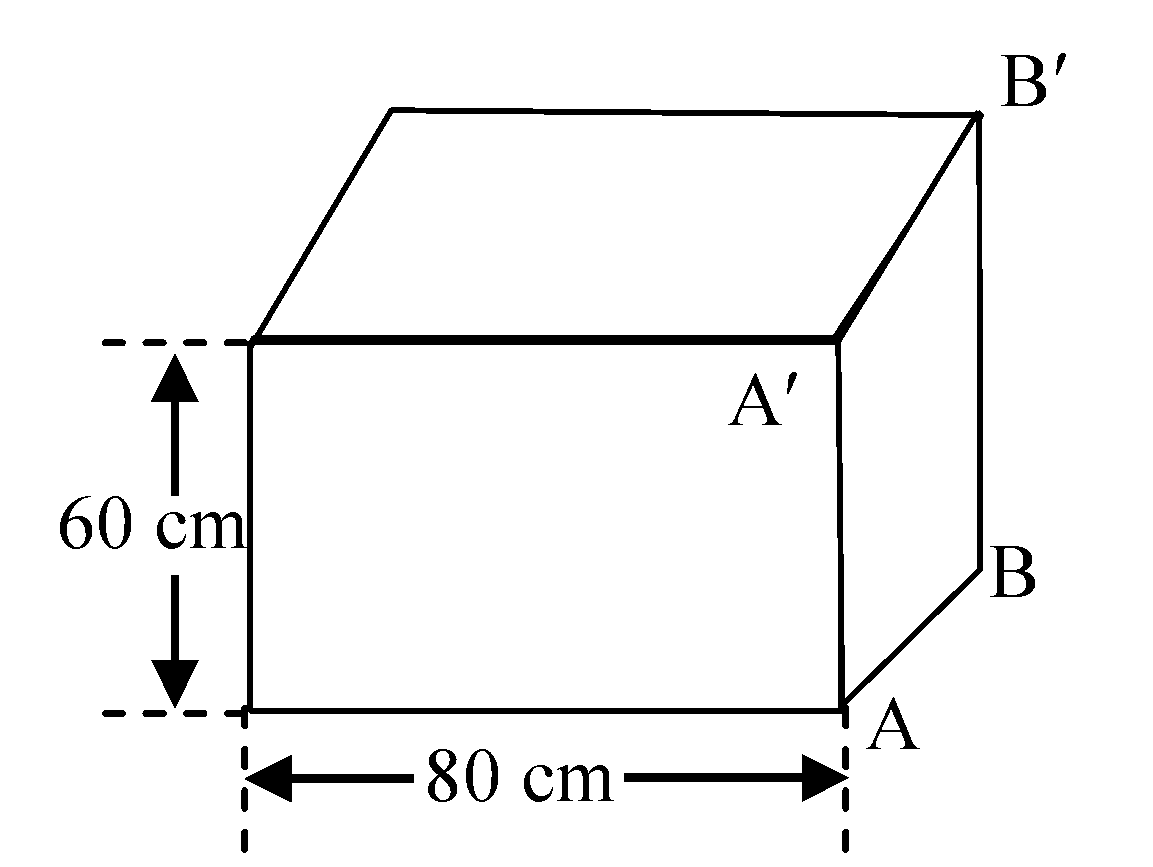
Calculate the minimum amount of work necessary to overturn a crate of weight 1 ton, first about edge AB, then about edge A ′ B ′ . The dimensions of the crate are given in Fig.
Text Solution
Verified by ExpertsThe correct answer is:
A
Step 1: Understand the problem
We need to calculate the work necessary to overturn a crate of weight 1 ton (1000 kg) about two edges: AB and A'B'.
Step 2: Determine the dimensions of the crate
Let’s assume the crate has dimensions: height (h) = 80 cm, width (w) = 1 m (100 cm), and length (l) = 40 cm (given in the figure). The weight of the crate (W) = mg = 1000 kg * 9.81 m/s² = 9810 N.
Step 3: Calculate the height of the center of mass (CM)
For a rectangular crate, the center of mass is located at half the dimensions. Thus, the height of the CM from the base is 40 cm (h/2) = 40 cm.
Step 4: Calculate the moment arm for each edge
1. For edge AB (considering height about AB):
- Moment arm = distance from the center of mass to edge AB = 40 cm = 0.4 m.
2. For edge A'B':
- Moment arm = total height of the crate - distance to CM = 80 cm - 40 cm = 40 cm = 0.4 m.
Step 5: Calculate the work done to overturn the crate
The work done (W) is given by the formula:
$$W = F imes d$$
Where F is the weight (9810 N) and d is the height of the CM in each case (0.4 m).
For both edges:
$$ W_{AB} = 9810 imes 0.4 $$
$$ W_{AB} = 3924 ext{ J} $$
$$ W_{A'B'} = 9810 imes 0.4 $$
$$ W_{A'B'} = 3924 ext{ J} $$
Step 6: Conclusion
The work done for both edges is the same due to symmetry, thus the minimum amount of work requires to overturn the crate about either edge is equal.
Therefore, the correct answer is A.
We need to calculate the work necessary to overturn a crate of weight 1 ton (1000 kg) about two edges: AB and A'B'.
Step 2: Determine the dimensions of the crate
Let’s assume the crate has dimensions: height (h) = 80 cm, width (w) = 1 m (100 cm), and length (l) = 40 cm (given in the figure). The weight of the crate (W) = mg = 1000 kg * 9.81 m/s² = 9810 N.
Step 3: Calculate the height of the center of mass (CM)
For a rectangular crate, the center of mass is located at half the dimensions. Thus, the height of the CM from the base is 40 cm (h/2) = 40 cm.
Step 4: Calculate the moment arm for each edge
1. For edge AB (considering height about AB):
- Moment arm = distance from the center of mass to edge AB = 40 cm = 0.4 m.
2. For edge A'B':
- Moment arm = total height of the crate - distance to CM = 80 cm - 40 cm = 40 cm = 0.4 m.
Step 5: Calculate the work done to overturn the crate
The work done (W) is given by the formula:
$$W = F imes d$$
Where F is the weight (9810 N) and d is the height of the CM in each case (0.4 m).
For both edges:
$$ W_{AB} = 9810 imes 0.4 $$
$$ W_{AB} = 3924 ext{ J} $$
$$ W_{A'B'} = 9810 imes 0.4 $$
$$ W_{A'B'} = 3924 ext{ J} $$
Step 6: Conclusion
The work done for both edges is the same due to symmetry, thus the minimum amount of work requires to overturn the crate about either edge is equal.
Therefore, the correct answer is A.
Prepare Smarter with CGP Edu
Get practice questions, solutions, and test series in one place.
Write a Review
Share your experience with this question and solution.
Commentary
Send your comment, doubt, correction, or feedback to admin.
Similar Questions
Explore conceptually related problems
A uniform disc of mass 2kg and radius 1m is mounted on an axle supported on fixed frictionless bear…
A solid sphere is resting over a rough horizontal floor. A sharp impulse is applied on it along its…
Select the wrong statement –
Statement-I : A body may be in pure rotation under the action of singl…
A ring of mass M and radius R sliding with a velocity v 0 suddenly enters into rough surface where …
A cylinder of mass m is kept on a inclined plane having angle of inclination 30 0 Axis of cylinder …
A uniform rod of mass 1 kg and length 1 m is kept vertical on the edge of a horizontal table. The r…