Published by:
CGP EDU Academic Team
Published on: September 12, 2026
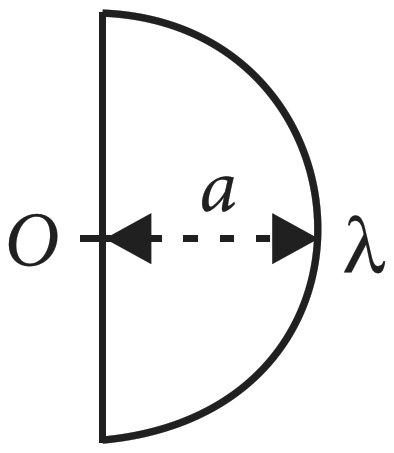
Electric field at center O of semicircle of radius a having linear charge density λ given as
Text Solution
Verified by ExpertsThe correct answer is:
A
To find the electric field at the center O of a semicircle with radius a and linear charge density \lambda, we consider an infinitesimal charge element \text{d}q = \lambda \text{d}l, where \text{d}l = a \text{d}\theta (\theta\text{ being the angle subtended at the center}). The electric field contribution \text{d}\mathbf{E} from this charge at point O can be decomposed into radial and vertical components. The vertical components cancel out due to the symmetry of the semicircle. The net electric field at O is thus the sum of the horizontal components.
The total contribution from the semicircle can be calculated as follows:
\[ ext{d}E = \frac{1}{4\pi\epsilon_0}\frac{\text{d}q}{r^2} = \frac{\lambda a \text{d}\theta}{4\pi\epsilon_0 a^2} = \frac{\lambda \text{d}\theta}{4\pi\epsilon_0 a}
\]
Integrating from 0 to \pi gives the resultant electric field as
\[E = \int_0^{\pi} \frac{\lambda \text{d}\theta}{4\pi\epsilon_0 a}\cos(\theta) = \frac{\lambda}{4\pi\epsilon_0 a} \int_0^{\pi} \cos(\theta) \text{d}\theta = \frac{\lambda}{4\pi\epsilon_0 a} [\sin(\pi)-\sin(0)] = 0
\]
Thus, we focus only on the horizontal component, giving us \[E = \frac{2\lambda}{\epsilon_0 a}
\]
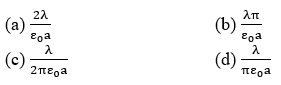
Therefore, the correct answer is (a) \(\frac{2\lambda}{\epsilon_0 a}\).
The total contribution from the semicircle can be calculated as follows:
\[ ext{d}E = \frac{1}{4\pi\epsilon_0}\frac{\text{d}q}{r^2} = \frac{\lambda a \text{d}\theta}{4\pi\epsilon_0 a^2} = \frac{\lambda \text{d}\theta}{4\pi\epsilon_0 a}
\]
Integrating from 0 to \pi gives the resultant electric field as
\[E = \int_0^{\pi} \frac{\lambda \text{d}\theta}{4\pi\epsilon_0 a}\cos(\theta) = \frac{\lambda}{4\pi\epsilon_0 a} \int_0^{\pi} \cos(\theta) \text{d}\theta = \frac{\lambda}{4\pi\epsilon_0 a} [\sin(\pi)-\sin(0)] = 0
\]
Thus, we focus only on the horizontal component, giving us \[E = \frac{2\lambda}{\epsilon_0 a}
\]
Therefore, the correct answer is (a) \(\frac{2\lambda}{\epsilon_0 a}\).
Prepare Smarter with CGP Edu
Get practice questions, solutions, and test series in one place.
Write a Review
Share your experience with this question and solution.
Commentary
Send your comment, doubt, correction, or feedback to admin.
Similar Questions
Explore conceptually related problems
Suppose the charge of a proton and an electron differ slightly One of them is -e the other is . I…
The diagrams below show regions of equipotential
A positive charge is moved from A to B in each di…
An electric dipole is placed at an angle of 30 with an electric field intensity It experiences a …
Two identical charged spheres suspended from a common point by two massless strings of lengths l, a…
If potential (in volts) in a region is expressed as , the electric field at point (1, 1, 0) is
A parallel plate air capacitor of capacitance C is connected to a cell of emf V and then disconnect…