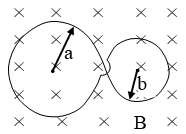
A plane loop is shaped in the form as shown in figure with radii a = 20 cm and b = 10 cm and is placed in a uniform time varying magnetic field B = B 0 sin ω t, where B 0 = 10 mT and ω = 100 rad/s. Find the amplitude of the current induced in the loop if its resistance per unit length is equal to 50 × 10 –3 Ω /m. The inductance of the loop is negligible
Text Solution
Verified by ExpertsThe correct answer is:
CHECK THE SOLUTION.
( 0001)
Sol. Instantaneous flux
= π a 2 B cos0° + π b 2 B cos180°
= π (a 2 – b 2 ) B
φ = π( a 2 – b 2 ) B 0 sin ω t
λ = 
i = 
i = 
R = ρ × 2 π (a + b)
∴ i max =  = 1 Amp
Prepare Smarter with CGP Edu
Get practice questions, solutions, and test series in one place.
Write a Review
Share your experience with this question and solution.
Commentary
Send your comment, doubt, correction, or feedback to admin.
Similar Questions
Explore conceptually related problems
The current in a coil changes from 4 ampere to zero in 0.1 s. If the average e.m.f. induced is 100 …
If in a coil rate of change of area is second and current become 1 amp from 2 amp in . If magnitu…
An e.m.f. of 12 volt is produced in a coil when the current in it changes at the rate of 45 amp/min…
An average induced e.m.f. of 1V appears in a coil when the current in it is changed from 10A in one…
If a change in current of 0.01 A in one coil produces a change in magnetic flux in the other coil,…
A solenoid of length l meter has self-inductance L henry. If number of turns are doubled, its self-…