A metal rod AB of length λ rotates with a constant angular velocity ω about an axis passing through O and normal to its length. Calculate potential difference between ends A and B if
(i) external magnetic field is absent;
(ii) an external uniform magnetic field of induction B directed parallel to the axis of rotation exists in the space.
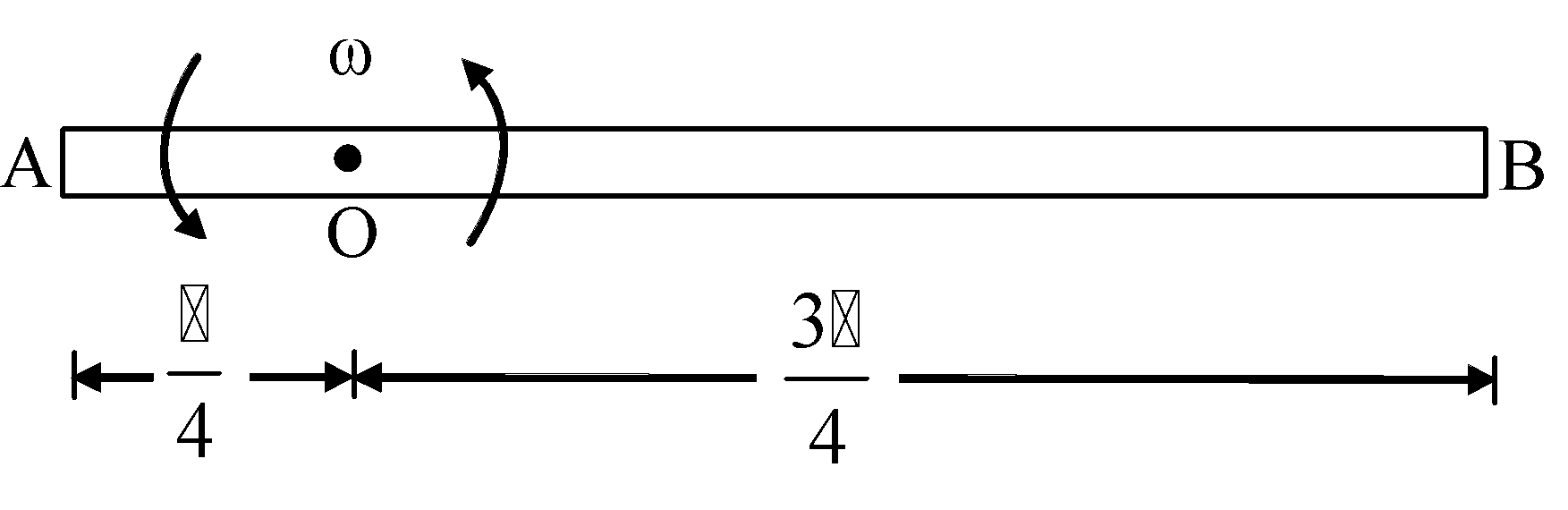
Text Solution
Verified by ExpertsCHECK THE SOLUTION.
Sol. (i) When external magnetic field is absent, Since, rod is made of a metal, therefore, if has free electrons. When is rotated, free electrons start to move radially outwards. Due to this, at ends rod becomes negatively charged and at O it becomes positively charge. Hence, a radial, electric field is established in the rod which exerts a radially inward force on electron.
Dynamic equilibrium is established when this radially inward force exerted by electric field becomes equal to centripetal force required for circular motion of electrons.
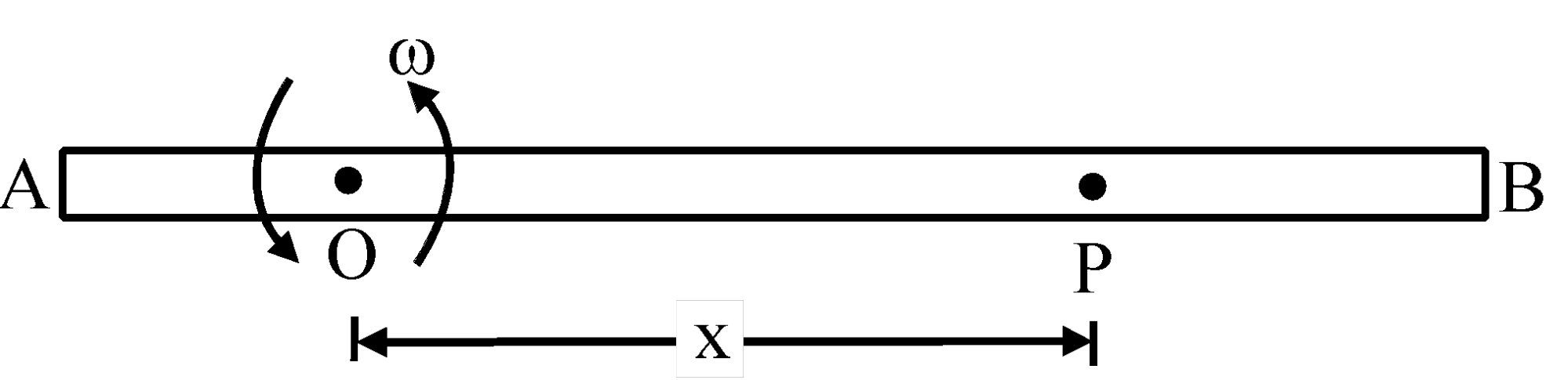
Consider a point P at distance x from axis of rotation O as shown in Fig.
Let electric field strength of this point be E. For dynamic equilibrium of a free electron at P,
mx ω 2 = eE or E = 
But E = – 
∴ dV = –  . xdx .....(1)
Let at end A, potential be V A and that at B be V B , Integrating equation (1),

or V B – V A = – 
or V A – V B = 
(ii) When a uniform magnetic field B exists, When rod rotates, it cuts magnetic flux, therefore, an emf is induced in the rod. Due to this emf a potential difference is established between its two ends.

Considering an elemental length dx of rod at a distance x from axis of rotation as shown in Fig. Velocity of this elemental length is
v = x ω
∴ EMF induced in elemental length dx is dV = Bvdx = B ω x dx
Integrating above equation,

V A – V B = 
Prepare Smarter with CGP Edu
Get practice questions, solutions, and test series in one place.
Write a Review
Share your experience with this question and solution.
Commentary
Send your comment, doubt, correction, or feedback to admin.
Similar Questions
Explore conceptually related problems