Published by:
CGP EDU Academic Team
Published on: September 12, 2026
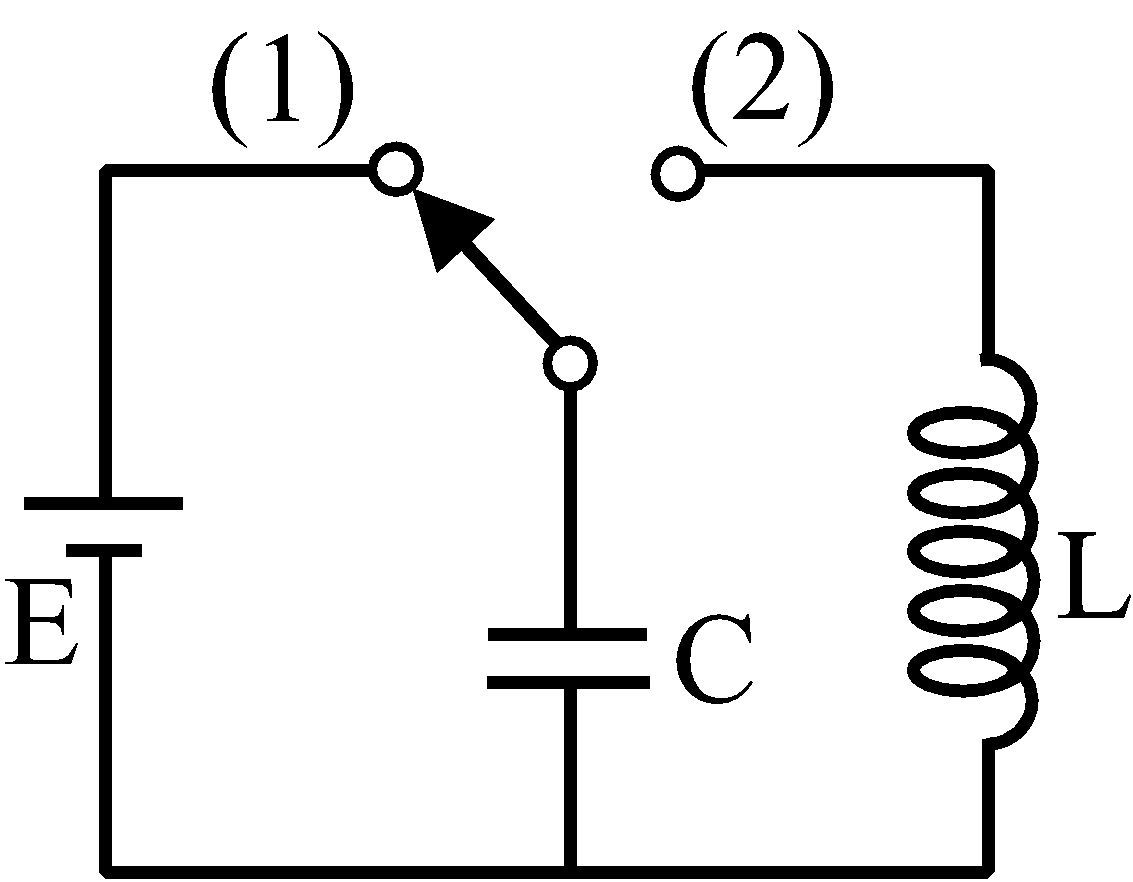
In the shown electrical network at t < 0, key was placed on (1) till the capacitor got fully charged. Key is placed on (2) at t = 0. Determine the time when the energy in both capacitor and inductor will be same for the first time.
Text Solution
Verified by ExpertsThe correct answer is:
A
Step 1: Analyze the circuit at t = 0.
The capacitor is initially charged and then switches to the inductor. Let the initial voltage across the capacitor be V.
Step 2: The energy stored in the capacitor (E_c) is given by \(E_c = \frac{1}{2} C V^2\).
Step 3: After the switch is placed at (2), the inductor will start to receive energy. The current in the inductor (i) can be expressed over time \(i(t) = \frac{V}{R}(1 - e^{-\frac{R}{L}t})\).
Step 4: The energy in the inductor (E_l) is given by \(E_l = \frac{1}{2} L i^2 = \frac{1}{2} L \left(\frac{V}{R}(1 - e^{-\frac{R}{L}t})\right)^2\).
Step 5: Set E_c = E_l and solve for t. This gives:\
\(\frac{1}{2} C V^2 = \frac{1}{2} L \left(\frac{V}{R}(1 - e^{-\frac{R}{L}t})\right)^2\)
Step 6: Further simplification leads to \(C = \frac{L}{R^2}(1 - e^{-\frac{R}{L}t})^2\).
Step 7: Solving this equation will give the specific time at which the energies are equal. Depending on the values of R, C, and L provided in the question, t should be calculated.
Therefore, the time when the energy in both the capacitor and inductor will be the same for the first time can be derived from this process.
The capacitor is initially charged and then switches to the inductor. Let the initial voltage across the capacitor be V.
Step 2: The energy stored in the capacitor (E_c) is given by \(E_c = \frac{1}{2} C V^2\).
Step 3: After the switch is placed at (2), the inductor will start to receive energy. The current in the inductor (i) can be expressed over time \(i(t) = \frac{V}{R}(1 - e^{-\frac{R}{L}t})\).
Step 4: The energy in the inductor (E_l) is given by \(E_l = \frac{1}{2} L i^2 = \frac{1}{2} L \left(\frac{V}{R}(1 - e^{-\frac{R}{L}t})\right)^2\).
Step 5: Set E_c = E_l and solve for t. This gives:\
\(\frac{1}{2} C V^2 = \frac{1}{2} L \left(\frac{V}{R}(1 - e^{-\frac{R}{L}t})\right)^2\)
Step 6: Further simplification leads to \(C = \frac{L}{R^2}(1 - e^{-\frac{R}{L}t})^2\).
Step 7: Solving this equation will give the specific time at which the energies are equal. Depending on the values of R, C, and L provided in the question, t should be calculated.
Therefore, the time when the energy in both the capacitor and inductor will be the same for the first time can be derived from this process.
Prepare Smarter with CGP Edu
Get practice questions, solutions, and test series in one place.
Write a Review
Share your experience with this question and solution.
Commentary
Send your comment, doubt, correction, or feedback to admin.
Similar Questions
Explore conceptually related problems
An electric motor operating on a 60 Vdc supply draws a current of 10 A. If the efficiency of the mo…
A thin semicircular conducting ring of the radius is falling with its plane vertical in a horizont…
At a place the value of horizontal component of the earth's magnetic field is Weber . A metallic…
A circular loop of radius carrying current I lies in plane with its centre at origin. The total m…
Two identical circular loops of metal wire are lying on a table without touching each other. Loop-A…
A small square loop of wire of side l is placed inside a large square loop of wire of side . The l…