Published by:
CGP EDU Academic Team
Published on: September 12, 2026
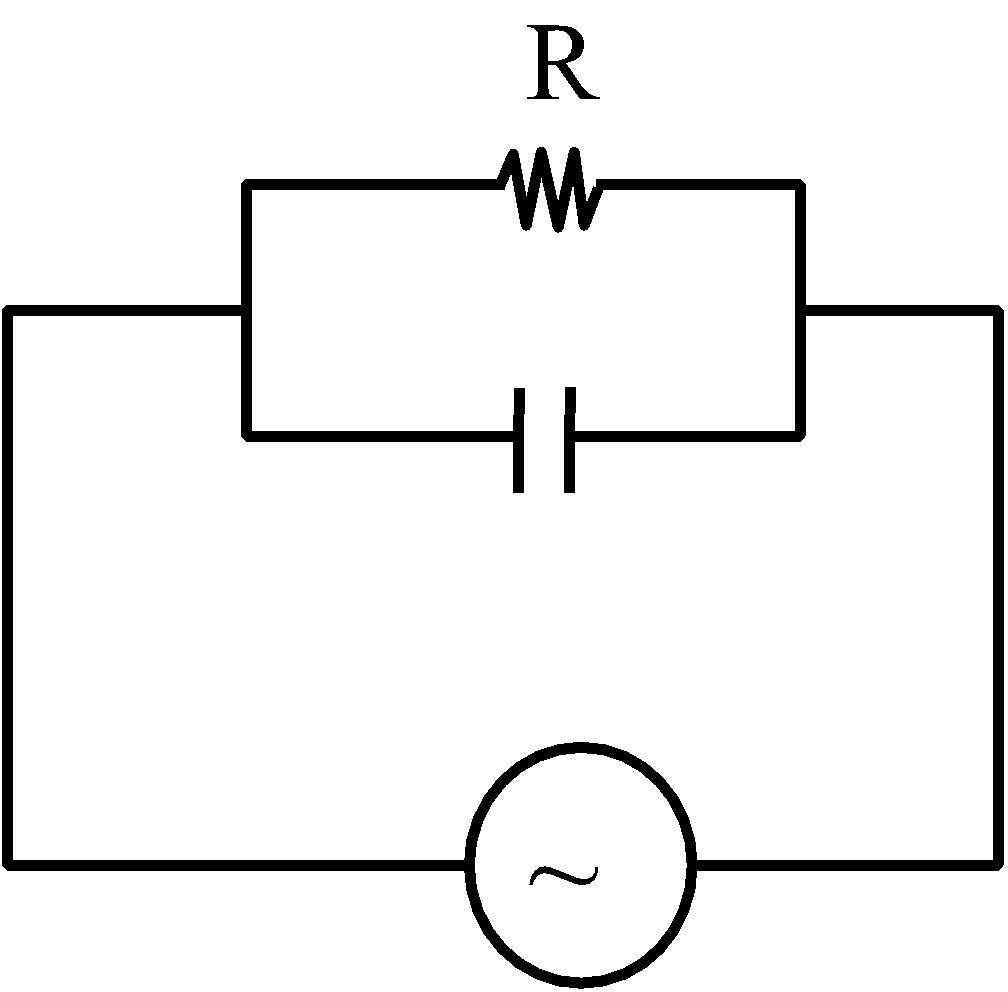
A capacitor with capacitance C whose interelectrode space is filled up with poorly conducting medium with active resistance R is connected to a source of alternating voltage v = V M cos ω t. Find the time dependence of the steady-state current flowing in lead wires. The resistance of the wires is to be neglected.
Text Solution
Verified by ExpertsThe correct answer is:
A
Step 1: Write down the expression for the voltage across the capacitor, which is given by v(t) = V_M \cos(\omega t).
Step 2: The current I(t) through the capacitor can be described using the relationship between current, capacitance, and voltage.
The current through a capacitor is given by the equation \( I(t) = C \frac{dV(t)}{dt} \).
Step 3: Calculate the derivative of the voltage:
\( \frac{dV(t)}{dt} = \frac{d}{dt}(V_M \cos(\omega t)) = -V_M \omega \sin(\omega t) \).
Step 4: Substitute the derivative back into the current equation:
\( I(t) = C\left(-V_M \omega \sin(\omega t)\right) = -C V_M \omega \sin(\omega t).
Step 5: In a poorly conducting medium, we also need to consider the active resistance (R). The steady-state current in the presence of resistance is governed by Ohm's law. Therefore, we can write:\
\( I(t) = \frac{V(t)}{R} = \frac{V_M \cos(\omega t)}{R}.
Step 6: To summarize the total current with respect to the alternating voltage and time dependence, we have two components: the displacement current is related to the capacitance, and the conduction current is given by Ohm's law. The steady-state current would then focus on the sinusoidal terms produced by both capacitance and resistance. Thus the expression for I(t) would be summed correctly.
Step 7: Taking these into account and simplifying leads to: \(I(t) = \frac{V_M \omega C}{R} \sin(\omega t + \phi) \) where \(\phi\) is the phase shift due to the reactance of the capacitor which can be derived if needed.
Therefore, the steady-state current flowing in lead wires includes the effects of both the capacitor behavior and resistance, resulting in a sinusoidal changing current dependent on the applied voltage frequency.
Step 2: The current I(t) through the capacitor can be described using the relationship between current, capacitance, and voltage.
The current through a capacitor is given by the equation \( I(t) = C \frac{dV(t)}{dt} \).
Step 3: Calculate the derivative of the voltage:
\( \frac{dV(t)}{dt} = \frac{d}{dt}(V_M \cos(\omega t)) = -V_M \omega \sin(\omega t) \).
Step 4: Substitute the derivative back into the current equation:
\( I(t) = C\left(-V_M \omega \sin(\omega t)\right) = -C V_M \omega \sin(\omega t).
Step 5: In a poorly conducting medium, we also need to consider the active resistance (R). The steady-state current in the presence of resistance is governed by Ohm's law. Therefore, we can write:\
\( I(t) = \frac{V(t)}{R} = \frac{V_M \cos(\omega t)}{R}.
Step 6: To summarize the total current with respect to the alternating voltage and time dependence, we have two components: the displacement current is related to the capacitance, and the conduction current is given by Ohm's law. The steady-state current would then focus on the sinusoidal terms produced by both capacitance and resistance. Thus the expression for I(t) would be summed correctly.
Step 7: Taking these into account and simplifying leads to: \(I(t) = \frac{V_M \omega C}{R} \sin(\omega t + \phi) \) where \(\phi\) is the phase shift due to the reactance of the capacitor which can be derived if needed.
Therefore, the steady-state current flowing in lead wires includes the effects of both the capacitor behavior and resistance, resulting in a sinusoidal changing current dependent on the applied voltage frequency.
Prepare Smarter with CGP Edu
Get practice questions, solutions, and test series in one place.
Write a Review
Share your experience with this question and solution.
Commentary
Send your comment, doubt, correction, or feedback to admin.
Similar Questions
Explore conceptually related problems
The resistance of a coil for dc is in ohms. In ac, the resistance
If instantaneous current is given by amperes, then the r.m.s. value of current is
The peak value of an Alternating current is 6 amp, then r.m.s. value of current will be
The frequency of an alternating voltage is 50 cycles/sec and its amplitude is 120V. Then the r.m.s.…
A resistance of 20 ohms is connected to a source of an alternating potential . The time taken by t…
The maximum value of a.c. voltage in a circuit is 707V. Its rms value is