Published by:
CGP EDU Academic Team
Published on: September 12, 2026
A current is made of two components, 3 amp d.c. component and an a.c. component given by I = 4 sin ω t amp. Find out an expression for the resultant current and calculate its effective value.
Text Solution
Verified by ExpertsThe correct answer is:
A
Step 1: Identify the components of the current.
The current consists of a direct current (d.c.) component: I_d = 3 ext{ A} and an alternating current (a.c.) component: I_a = 4 ext{ sin } heta = 4 ext{ sin } ( ext{ } ext{ } ext{ } ext{ u } t).
Step 2: Write the expression for the resultant current.
The total current (I) at any time (t) can be expressed as the sum of the d.c. and a.c. components:
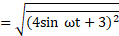
I(t) = I_d + I_a = 3 + 4 ext{ sin } ( u t).
Step 3: Calculate the effective value (RMS value) of the resultant current.
The effective value (or RMS value) of a d.c. component is simply its value.
The RMS value of a sinusoidal a.c. component is given by: \frac{I_a}{\sqrt{2}}. Here, \( I_a = 4 \), so:
\text{RMS value of } I_a = \frac{4}{\sqrt{2}} = 2\sqrt{2} ext{ A}.
Step 4: Combine the d.c. component with the effective value of the a.c. component. Since the d.c. component does not vary with time, the effective value of the resultant current is given by the square root of the sum of squares of the d.c. and a.c. RMS values:
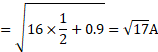
I_{rms} = \sqrt{I_d^2 + I_{a_{rms}}^2} = \sqrt{3^2 + (2\sqrt{2})^2} = \sqrt{9 + 8} = \sqrt{17} ext{ A}.
Thus, the effective value of the resultant current is \sqrt{17} ext{ A}.
The current consists of a direct current (d.c.) component: I_d = 3 ext{ A} and an alternating current (a.c.) component: I_a = 4 ext{ sin } heta = 4 ext{ sin } ( ext{ } ext{ } ext{ } ext{ u } t).
Step 2: Write the expression for the resultant current.
The total current (I) at any time (t) can be expressed as the sum of the d.c. and a.c. components:
I(t) = I_d + I_a = 3 + 4 ext{ sin } ( u t).
Step 3: Calculate the effective value (RMS value) of the resultant current.
The effective value (or RMS value) of a d.c. component is simply its value.
The RMS value of a sinusoidal a.c. component is given by: \frac{I_a}{\sqrt{2}}. Here, \( I_a = 4 \), so:
\text{RMS value of } I_a = \frac{4}{\sqrt{2}} = 2\sqrt{2} ext{ A}.
Step 4: Combine the d.c. component with the effective value of the a.c. component. Since the d.c. component does not vary with time, the effective value of the resultant current is given by the square root of the sum of squares of the d.c. and a.c. RMS values:
I_{rms} = \sqrt{I_d^2 + I_{a_{rms}}^2} = \sqrt{3^2 + (2\sqrt{2})^2} = \sqrt{9 + 8} = \sqrt{17} ext{ A}.
Thus, the effective value of the resultant current is \sqrt{17} ext{ A}.
Prepare Smarter with CGP Edu
Get practice questions, solutions, and test series in one place.
Write a Review
Share your experience with this question and solution.
Commentary
Send your comment, doubt, correction, or feedback to admin.
Similar Questions
Explore conceptually related problems
In an -circuit, the inductive reactance is equal to the resistance of the circuit. An e.m.f. app…
In the circuit given below, what will be the reading of the voltmeter
In the circuit shown below, what will be the readings of the voltmeter and ammeter
A bulb and a capacitor are connected in series to a source of alternating current. If its frequency…
An alternating e.m.f. of angular frequency is applied across an inductance. The instantaneous powe…
The voltage of an ac source varies with time according to the equation where is in seconds and i…