Published by:
CGP EDU Academic Team
Published on: September 12, 2026
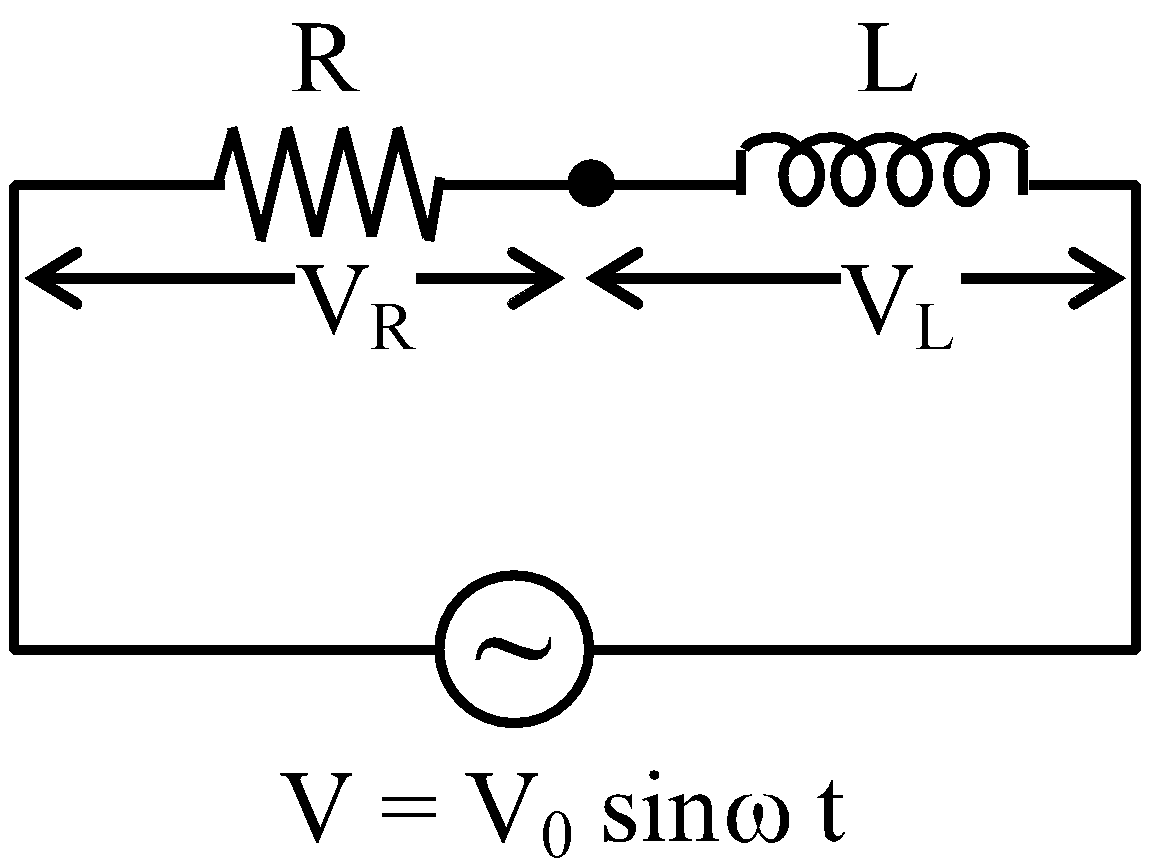
The shown alternating current circuit has a resistance less coil L and a resistance R. The potential difference across the choke is V L = 160 volt and the potential difference across the resistance is V R = 120 volt. Find the virtual value of the applied voltage. If the virtual current in the circuit is 1.0 ampere, then calculate the total impedance of the circuit. If a direct current be passed in the circuit, then what will be the potential difference in the circuit?
Text Solution
Verified by ExpertsThe correct answer is:
A
Step 1: Calculate the applied voltage (Va)
In an AC circuit with a resistor (R) and an inductor (L), the applied voltage can be found using the formula:
$$ V_a = \\sqrt{V_R^2 + V_L^2} $$
Given, VR = 120 V and VL = 160 V:
$$ V_a = \\sqrt{(120)^2 + (160)^2} $$
$$ V_a = \\sqrt{14400 + 25600} $$
$$ V_a = \\sqrt{40000} $$
$$ V_a = 200 ext{ volts} $$
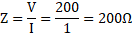
Step 2: Calculate total impedance (Z)
The total impedance can be calculated using Ohm's law:
$$ Z = \\frac{V_a}{I} $$
Where I = 1.0 A. Therefore,
$$ Z = \\frac{200}{1.0} $$
$$ Z = 200 ext{ ohms} $$
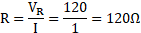
Step 3: Calculate the potential difference in case of direct current
In a direct current circuit, the total voltage is equal to the sum of the voltage across the resistor and the inductive reactance. However, inductance does not influence direct current since it only has a resistive component:
Therefore, the potential difference Vdc in a DC circuit will equal the voltage across the resistor:
$$ V_{dc} = V_R = 120 ext{ volts} $$
Final Answer: The virtual value of the applied voltage is 200 volts, the total impedance is 200 ohms, and the potential difference in a DC circuit is 120 volts.
In an AC circuit with a resistor (R) and an inductor (L), the applied voltage can be found using the formula:
$$ V_a = \\sqrt{V_R^2 + V_L^2} $$
Given, VR = 120 V and VL = 160 V:
$$ V_a = \\sqrt{(120)^2 + (160)^2} $$
$$ V_a = \\sqrt{14400 + 25600} $$
$$ V_a = \\sqrt{40000} $$
$$ V_a = 200 ext{ volts} $$
Step 2: Calculate total impedance (Z)
The total impedance can be calculated using Ohm's law:
$$ Z = \\frac{V_a}{I} $$
Where I = 1.0 A. Therefore,
$$ Z = \\frac{200}{1.0} $$
$$ Z = 200 ext{ ohms} $$
Step 3: Calculate the potential difference in case of direct current
In a direct current circuit, the total voltage is equal to the sum of the voltage across the resistor and the inductive reactance. However, inductance does not influence direct current since it only has a resistive component:
Therefore, the potential difference Vdc in a DC circuit will equal the voltage across the resistor:
$$ V_{dc} = V_R = 120 ext{ volts} $$
Final Answer: The virtual value of the applied voltage is 200 volts, the total impedance is 200 ohms, and the potential difference in a DC circuit is 120 volts.
Prepare Smarter with CGP Edu
Get practice questions, solutions, and test series in one place.
Write a Review
Share your experience with this question and solution.
Commentary
Send your comment, doubt, correction, or feedback to admin.
Similar Questions
Explore conceptually related problems
In an -circuit, the inductive reactance is equal to the resistance of the circuit. An e.m.f. app…
In the circuit given below, what will be the reading of the voltmeter
In the circuit shown below, what will be the readings of the voltmeter and ammeter
A bulb and a capacitor are connected in series to a source of alternating current. If its frequency…
An alternating e.m.f. of angular frequency is applied across an inductance. The instantaneous powe…
The voltage of an ac source varies with time according to the equation where is in seconds and i…