Published by:
CGP EDU Academic Team
Published on: September 12, 2026
An e.m.f. E = 150 cos 314t volts is applied to a purely resistive branch having R= 30 ohms. Find out expressions for current and power as a function of time. Also calculate the frequencies of current and power variations.
Text Solution
Verified by ExpertsThe correct answer is:
A
Step 1: Given the e.m.f. expression:
$$ E(t) = 150 \, \cos(314t) \text{ volts} $$
Step 2: We know that the current through a purely resistive circuit is given by Ohm's law:
$$ I(t) = \frac{E(t)}{R} $$
Substituting the values we have:
$$ I(t) = \frac{150 \, \cos(314t)}{30} $$
Simplifying this gives:
$$ I(t) = 5 \, \cos(314t) \text{ amperes} $$
Step 3: Now, we need to find the power as a function of time. The instantaneous power consumed in a resistive circuit can be expressed as:
$$ P(t) = I(t)^2 \cdot R $$
Substituting the expression of current we found earlier:
$$ P(t) = (5 \, \cos(314t))^2 \cdot 30 $$
This simplifies to:
$$ P(t) = 25 \, \cos^2(314t) \cdot 30 $$
$$ P(t) = 750 \, \cos^2(314t) \text{ watts} $$
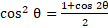
We can now use the trigonometric identity for cosine squared: $$ \cos^2(x) = \frac{1 + \cos(2x)}{2} $$
So we replace $$ \cos^2(314t) $$:
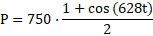
$$ P(t) = 750 \cdot \frac{1 + \cos(628t)}{2} $$
$$ P(t) = 375 + 375 \cdot \cos(628t) \text{ watts} $$
Step 4: Now, we can determine the frequencies of current and power variations. The frequency can be found from the argument of the cosine function which is of the form $$ \cos(\omega t) $$:
- For current, $$ \omega_{current} = 314 \implies f_{current} = \frac{314}{2\pi} \approx 50 \text{ Hz} $$
- For power, $$ \omega_{power} = 628 \implies f_{power} = \frac{628}{2\pi} \approx 100 \text{ Hz} $$
Final Answers:
The expressions for current and power as a function of time are:
$$ I(t) = 5 \, \cos(314t) \text{ amperes} $$
$$ P(t) = 375 + 375 \cdot \cos(628t) \text{ watts} $$
The frequency of current variations is approximately 50 Hz and the frequency of power variations is approximately 100 Hz.
$$ E(t) = 150 \, \cos(314t) \text{ volts} $$
Step 2: We know that the current through a purely resistive circuit is given by Ohm's law:
$$ I(t) = \frac{E(t)}{R} $$
Substituting the values we have:
$$ I(t) = \frac{150 \, \cos(314t)}{30} $$
Simplifying this gives:
$$ I(t) = 5 \, \cos(314t) \text{ amperes} $$
Step 3: Now, we need to find the power as a function of time. The instantaneous power consumed in a resistive circuit can be expressed as:
$$ P(t) = I(t)^2 \cdot R $$
Substituting the expression of current we found earlier:
$$ P(t) = (5 \, \cos(314t))^2 \cdot 30 $$
This simplifies to:
$$ P(t) = 25 \, \cos^2(314t) \cdot 30 $$
$$ P(t) = 750 \, \cos^2(314t) \text{ watts} $$
We can now use the trigonometric identity for cosine squared: $$ \cos^2(x) = \frac{1 + \cos(2x)}{2} $$
So we replace $$ \cos^2(314t) $$:
$$ P(t) = 750 \cdot \frac{1 + \cos(628t)}{2} $$
$$ P(t) = 375 + 375 \cdot \cos(628t) \text{ watts} $$
Step 4: Now, we can determine the frequencies of current and power variations. The frequency can be found from the argument of the cosine function which is of the form $$ \cos(\omega t) $$:
- For current, $$ \omega_{current} = 314 \implies f_{current} = \frac{314}{2\pi} \approx 50 \text{ Hz} $$
- For power, $$ \omega_{power} = 628 \implies f_{power} = \frac{628}{2\pi} \approx 100 \text{ Hz} $$
Final Answers:
The expressions for current and power as a function of time are:
$$ I(t) = 5 \, \cos(314t) \text{ amperes} $$
$$ P(t) = 375 + 375 \cdot \cos(628t) \text{ watts} $$
The frequency of current variations is approximately 50 Hz and the frequency of power variations is approximately 100 Hz.
Prepare Smarter with CGP Edu
Get practice questions, solutions, and test series in one place.
Write a Review
Share your experience with this question and solution.
Commentary
Send your comment, doubt, correction, or feedback to admin.
Similar Questions
Explore conceptually related problems
The power is transmitted from a power house on high voltage ac because
The potential difference V and the current i flowing through an instrument in an ac circuit of freq…
In an ac circuit, V and I are given by volts, . The power dissipated in circuit is
Alternating current cannot be measured by dc ammeter because
In an ac circuit, peak value of voltage is 423 volts. Its effective voltage is
In an ac circuit . The time required for the current to achieve its peak value will be