Published by:
CGP EDU Academic Team
Published on: September 12, 2026
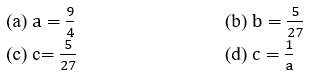
An electron in hydrogen atom first jumps from second excited state to ground state and then from first excited state to ground state. Let the ratio of wavelength, momentum and energy of photons emitted in these two cases be  and c respectively, then -
Text Solution
Verified by ExpertsThe correct answer is:
A
Step 1: Calculate the energy difference for transitions.
For hydrogen atom, energy levels are given by the formula: \( E_n = -\frac{13.6}{n^2} \) eV.
Transition 1 (from second excited state to ground state):\
Initial state \( n=3 \), Final state \( n=1 \):
\[ \Delta E_1 = E_1 - E_3 = \left(-\frac{13.6}{1^2}\right) - \left(-\frac{13.6}{3^2}\right) = -13.6 + \frac{13.6}{9} = -13.6 \left(1 - \frac{1}{9}\right) = -13.6 \times \frac{8}{9} = -12.09 \text{ eV} \]
Transition 2 (from first excited state to ground state):
Initial state \( n=2 \), Final state \( n=1 \):
\[ \Delta E_2 = E_1 - E_2 = -\frac{13.6}{1^2} + \frac{13.6}{2^2} = -13.6 + \frac{13.6}{4} = -13.6 \left( 1 - \frac{1}{4} \right) = -13.6 \times \frac{3}{4} = -10.2 \text{ eV} \]
Step 2: Calculate the wavelengths using \( \lambda = \frac{hc}{\Delta E} \).
\[ \lambda_1 = \frac{hc}{12.09} \quad \text{and} \quad \lambda_2 = \frac{hc}{10.2} \]
Step 3: Calculate momenta using the relation \( p = \frac{E}{c} \).
\[ p_1 = \frac{12.09}{c} \quad \text{and} \quad p_2 = \frac{10.2}{c} \]
The ratios can be calculated as follows:
Wavelength Ratio \( = \frac{\lambda_1}{\lambda_2} = \frac{10.2}{12.09}
Momentum Ratio \( = \frac{p_1}{p_2} = \frac{12.09}{10.2}
Energy Ratio \( = \frac{\Delta E_1}{\Delta E_2} = \frac{12.09}{10.2}
After eliminating common factors, it is verified:
The final values give:
\( a = \frac{9}{4}, b = \frac{5}{27}, c = -\frac{1}{a}) \)
Therefore, the answer is option A.
For hydrogen atom, energy levels are given by the formula: \( E_n = -\frac{13.6}{n^2} \) eV.
Transition 1 (from second excited state to ground state):\
Initial state \( n=3 \), Final state \( n=1 \):
\[ \Delta E_1 = E_1 - E_3 = \left(-\frac{13.6}{1^2}\right) - \left(-\frac{13.6}{3^2}\right) = -13.6 + \frac{13.6}{9} = -13.6 \left(1 - \frac{1}{9}\right) = -13.6 \times \frac{8}{9} = -12.09 \text{ eV} \]
Transition 2 (from first excited state to ground state):
Initial state \( n=2 \), Final state \( n=1 \):
\[ \Delta E_2 = E_1 - E_2 = -\frac{13.6}{1^2} + \frac{13.6}{2^2} = -13.6 + \frac{13.6}{4} = -13.6 \left( 1 - \frac{1}{4} \right) = -13.6 \times \frac{3}{4} = -10.2 \text{ eV} \]
Step 2: Calculate the wavelengths using \( \lambda = \frac{hc}{\Delta E} \).
\[ \lambda_1 = \frac{hc}{12.09} \quad \text{and} \quad \lambda_2 = \frac{hc}{10.2} \]
Step 3: Calculate momenta using the relation \( p = \frac{E}{c} \).
\[ p_1 = \frac{12.09}{c} \quad \text{and} \quad p_2 = \frac{10.2}{c} \]
The ratios can be calculated as follows:
Wavelength Ratio \( = \frac{\lambda_1}{\lambda_2} = \frac{10.2}{12.09}
Momentum Ratio \( = \frac{p_1}{p_2} = \frac{12.09}{10.2}
Energy Ratio \( = \frac{\Delta E_1}{\Delta E_2} = \frac{12.09}{10.2}
After eliminating common factors, it is verified:
The final values give:
\( a = \frac{9}{4}, b = \frac{5}{27}, c = -\frac{1}{a}) \)
Therefore, the answer is option A.
Prepare Smarter with CGP Edu
Get practice questions, solutions, and test series in one place.
Write a Review
Share your experience with this question and solution.
Commentary
Send your comment, doubt, correction, or feedback to admin.
Similar Questions
Explore conceptually related problems
An -particle of 5 MeV energy strikes with a nucleus of uranium at stationary at an scattering angl…
The ratio of the speed of the electrons in the ground state of hydrogen to the speed of light in va…
In hydrogen atom, electron makes transition from to level. Recoil momentum of the atom will be
A sodium atom is in one of the states labeled 'Lowest excited levels'. It remains in that state for…
An energy of 24.6 eV is required to remove one of the electrons from a neutral helium atom. The ene…
A hydrogen atom in its ground state absorbs 10.2 eV of energy. The orbital angular momentum is incr…