Physics Electrostatics Potential & Capacitance Electric Potential and Potential Difference Single Correct MCQ
Published on: September 12, 2026

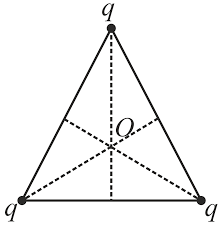
Three equal charges are placid at the three corners of an isosceles triangle as shown in the figure. The statement which is true for electric potential V and the field intensity E at the center of the triangle -
A
V = 0, E = 0
B
V = 0, E ≠ 0
C
V ≠ 0, E = 0
D
V ≠ 0, E ≠ 0

Share this question

For Instagram sharing, use “Apps” on mobile or copy the link.

Text Solution

Verified by Experts
The correct answer is:
B
Step 1: Understand the configuration. We have three equal charges, q, located at the corners of an isosceles triangle. The center of the triangle is denoted as point O.
Step 2: Electric Potential (V). The electric potential at a point due to a charge is given by the formula:
$$ V = k \frac{q}{r} $$
where k is Coulomb's constant, q is the charge, and r is the distance from the charge to the point. Since the electric potentials due to all three charges will add up, and they are symmetric with respect to the center of the triangle (point O), we find that:
$$ V_{total} = V_1 + V_2 + V_3 = k \frac{q}{r_1} + k \frac{q}{r_2} + k \frac{q}{r_3} $$
where r1, r2, and r3 are distances from the charges to O (which are not equal in this case due to the isosceles triangle configuration). Thus, V is not equal to 0 as these contributions will sum up to a non-zero value if the triangle is not equilateral, making V ≠ 0.
Step 3: Electric Field (E). The electric field intensity at point O due to each charge can be expressed as:
$$ E = k \frac{q}{r^2} $$
The directional components of the electric fields due to the two equal charges at the base of the triangle will cancel each other out in the vertical direction, and the charge at the top will contribute an electric field pointing downwards. Thus, the electric field is not zero:
Specifically, the components of the electric fields from the two base charges will cancel each other perfectly in the horizontal direction (they point away from each other), but their vertical components will add up due to the top charge.
Therefore, we conclude that: V ≠ 0 and E ≠ 0.
Conclusion: The correct option is B: V = 0, E ≠ 0 is incorrect; we have shown V ≠ 0 and E ≠ 0.

Prepare Smarter with CGP Edu

Get practice questions, solutions, and test series in one place.

Write a Review

Share your experience with this question and solution.

Commentary

Send your comment, doubt, correction, or feedback to admin.

Student Reviews

What students say about this solution

No reviews yet. Be the first to write a review.

Similar Questions

Explore conceptually related problems

CG
CGP Question Assistant Question Bank + AI Help
Hi! Type your question or upload one screenshot. First I will search related questions from CGP Edu Question Bank. If none match, type YES and I will solve it with AI.
Upload only one screenshot at a time. Flow: Question Bank first → If not matched, type YES for AI solution.