Published by:
CGP EDU Academic Team
Published on: September 12, 2026
Gauss law is given by
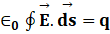
, if net charge enclosed by Guassian surface is zero then –
Text Solution
Verified by ExpertsThe correct answer is:
B
Gauss's law states that the electric flux through a closed surface is proportional to the net charge enclosed within that surface, expressed mathematically as: \( \varepsilon_0 \int \vec{E} \cdot d extbf{s} = q \).
In the case where the net charge (\( q \)) enclosed by the Gaussian surface is zero, the equation becomes:
\( \varepsilon_0 \int \vec{E} \cdot d extbf{s} = 0 \).
This means that the total electric flux through the surface is zero. Since electric flux is defined as the difference between the incoming and outgoing electric field lines, this indicates that the total incoming electric field lines equal the total outgoing electric field lines. Therefore, option B, which states that incoming and outgoing electric lines are equal, is correct.
Options A, C, and D are incorrect because having a net enclosed charge of zero does not imply that the electric field on the surface must be zero, nor does it imply there is a net incoming flux.
In the case where the net charge (\( q \)) enclosed by the Gaussian surface is zero, the equation becomes:
\( \varepsilon_0 \int \vec{E} \cdot d extbf{s} = 0 \).
This means that the total electric flux through the surface is zero. Since electric flux is defined as the difference between the incoming and outgoing electric field lines, this indicates that the total incoming electric field lines equal the total outgoing electric field lines. Therefore, option B, which states that incoming and outgoing electric lines are equal, is correct.
Options A, C, and D are incorrect because having a net enclosed charge of zero does not imply that the electric field on the surface must be zero, nor does it imply there is a net incoming flux.
Prepare Smarter with CGP Edu
Get practice questions, solutions, and test series in one place.
Write a Review
Share your experience with this question and solution.
Commentary
Send your comment, doubt, correction, or feedback to admin.
Similar Questions
Explore conceptually related problems
Total flux coming out of some closed surface is:
Three charges q 1 = 1 × 10 –6 , q 2 = 2 × 10 –6 , q 3 = –3 × 10 –6 C have been placed, as shown in …
The intensity of an electric field at some point distant r from the axis of infinite long pipe havi…
Eight charges, 1µC, -7µC, -4µC, 10µC, 2µC, -5µC, -3µC and 6µC are situated at the eight corners of …
A charge q is placed at the center of the cubical vessel (with one face open) as shown in figure. T…
If the geometric axis of cylinder is parallel to the electric field, the flux through the cylinder …