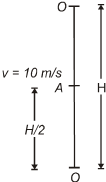
A ball is thrown vertically upward. It has a speed of 10 m/s when it has reached one half of its maximum height. How high does the ball rise? (Taking g = 10 m/s 2 )
Text Solution
Verified by ExpertsThe correct answer is:
B
The problem can be solved using third equation of motion at A and O'.
Let maximum height attained by the ball be H. Third equation of motion gives
v 2 = u 2 – 2gh
At A, (10) 2 = u 2 – 2 × 10 × 
⇒ v 2 = 100 + 10H … (i)
At O', (0) 2 = u 2 – 2 × 10 × H
⇒ u 2 = 20 H
Thus, from Eqs. (i) and (ii), we get
20H = 100 + 10H
⇒ 10H = 100 ∴ H = 10 m
Prepare Smarter with CGP Edu
Get practice questions, solutions, and test series in one place.
Write a Review
Share your experience with this question and solution.
Commentary
Send your comment, doubt, correction, or feedback to admin.
Similar Questions
Explore conceptually related problems
Which one of the following equations represent the motion of a body with finite constant non-zero a…
A ball is thrown upward and reaches a height of 64 feet, its initial velocity should be (g = 32 ft/…
Two bodies of different masses ma and mb are dropped from two different heights, viz a and b. The r…
A body thrown up with a finite speed is caught back after 4 sec. The speed of the body with which i…
A body is thrown upward and reaches its maximum height. At that position
The initial velocity of a particle (at t = 0) is u and the acceleration f of particle at time t is …