A balloon with mass 'm' is descending down with an acceleration 'a' (where a < g). How much mass should be removed from it so that is starts moving up with an acceleration 'a'?
A

B

C

D

Text Solution
Verified by ExpertsThe correct answer is:
A
mg – F = ma .....

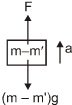
F – (m – m') g = (m – m') a
from
F – mg + m ′ g = ma – m ′ a
mg – ma – mg + m ′ g = ma – m ′ a
m ′ (g + a) = 2ma
m ′ = 
Prepare Smarter with CGP Edu
Get practice questions, solutions, and test series in one place.
Write a Review
Share your experience with this question and solution.
Commentary
Send your comment, doubt, correction, or feedback to admin.
Similar Questions
Explore conceptually related problems
A block of mass 10 kg is in contact against the inner wall of a hollow cylindrical drum of radius 1…
An object flying in air with velocity suddenly breaks in two pieces whose masses are in the ratio …
Which one of the following statements is incorrect?.
Two blocks A and B of masses 3m and m respectively are connected by a massless and inextensible str…
One end of string of length l is connected to a particle of mass m and the other end is connected t…
A rigid ball of mass m strikes a rigid wall at 60 and gets reflected without loss of speed as show…