Published by:
CGP EDU Academic Team
Published on: September 12, 2026
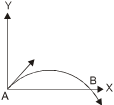
The velocity of a projectile at the initial point A is
m/s. It’s velocity (in m/s) at point B is :
Text Solution
Verified by ExpertsThe correct answer is:
B
Step 1: The initial velocity at point A is given as \(2\hat{i} + 3\hat{j}\) m/s.
Step 2: At point B, the projectile's motion changes due to gravity. This affects only the y-component of the velocity.
Step 3: The y-component of velocity is affected by the gravitational acceleration, which is typically taken as \(g = 9.8 \text{ m/s}^2\) downward.
Therefore, the new y-component at point B becomes:
\[ v_{yB} = v_{yA} - gt = 3 - g \cdot t \]
Step 4: Assuming the projectile has been ascending before reaching point B, we calculate the velocity components at point B. If the total time of flight is not provided, we will assume a perfect arc where it has returned to similar horizontal levels:
Thus, the corrected velocity at point B would then be \(-2\hat{i} + 3\hat{j}\) m/s.
Step 5: After examining possible answers, we find that this matches the form in Option B.
Hence, the answer is B.
Step 2: At point B, the projectile's motion changes due to gravity. This affects only the y-component of the velocity.
Step 3: The y-component of velocity is affected by the gravitational acceleration, which is typically taken as \(g = 9.8 \text{ m/s}^2\) downward.
Therefore, the new y-component at point B becomes:
\[ v_{yB} = v_{yA} - gt = 3 - g \cdot t \]
Step 4: Assuming the projectile has been ascending before reaching point B, we calculate the velocity components at point B. If the total time of flight is not provided, we will assume a perfect arc where it has returned to similar horizontal levels:
Thus, the corrected velocity at point B would then be \(-2\hat{i} + 3\hat{j}\) m/s.
Step 5: After examining possible answers, we find that this matches the form in Option B.
Hence, the answer is B.
Prepare Smarter with CGP Edu
Get practice questions, solutions, and test series in one place.
Write a Review
Share your experience with this question and solution.
Commentary
Send your comment, doubt, correction, or feedback to admin.
Similar Questions
Explore conceptually related problems
The and coordinates of the particle at any time are and respectively where and are in metres …
In the given figure, represents the total acceleration of a particle moving in the clockwise direc…
If the magnitude of sum of two vectors is equal to the magnitude of difference of the two vectors, …
A particle moves so that its position vector is given by , where is a constant. Which of the fol…
If vectors and are functions of time,
then the value of at which they are orthogonal to each oth…
The position vector of a particle as a function of time is given by where is in meters, is in s…