Published by:
CGP EDU Academic Team
Published on: September 12, 2026
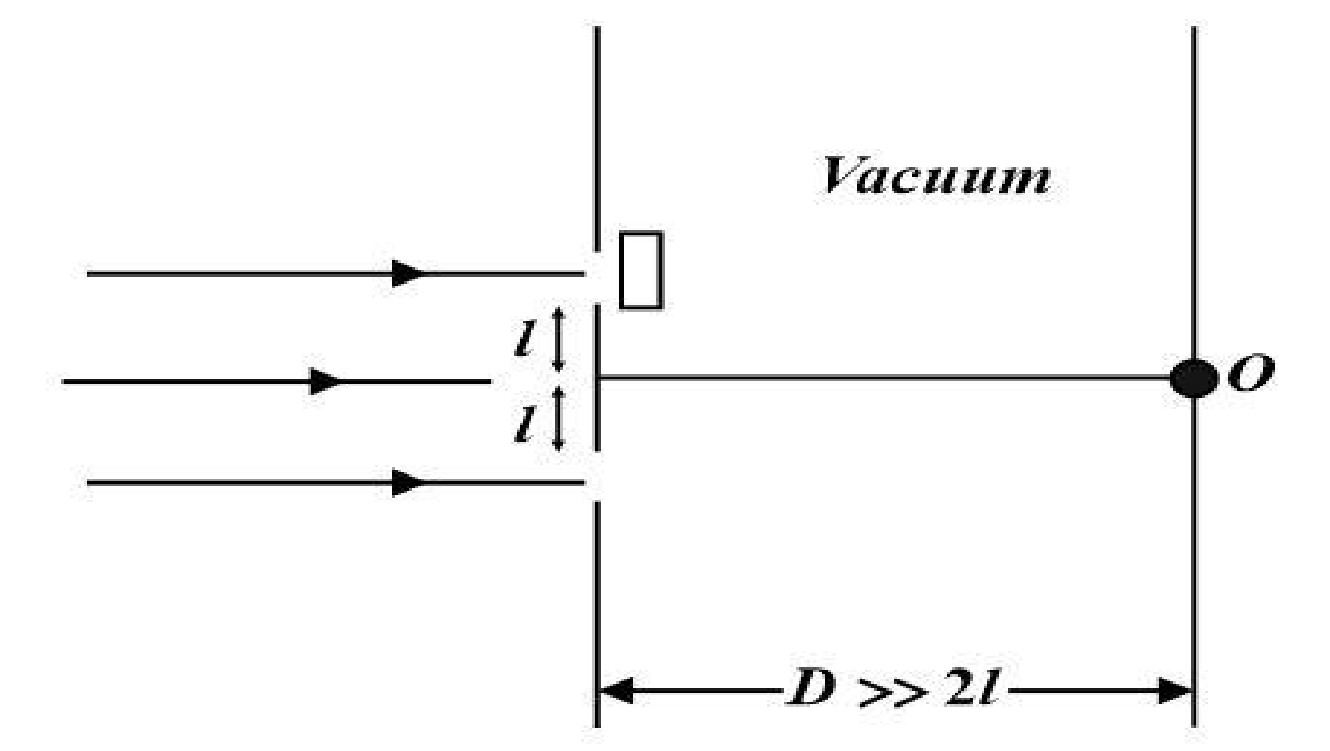
In Young's double-slit experiment, both the slits produce equal intensities on a screen. A 100% transparent thin film of refractive index

= 1.5 is kept in front of one of the slits, due to which the intensity at the point O on the screen becomes 75% of its initial value. If the wavelength of monochromatic light is 720 nm, then what is the minimum thickness (in nm) of the film?
Text Solution
Verified by ExpertsThe correct answer is:
A
Step 1: In Young's double-slit experiment, the intensity at point O can be described using the formula for intensity when there is a film in front of one of the slits. The intensity is affected by the refractive index of the film (n = 1.5) and the thickness (t) of the film.
Step 2: The intensity at point O initially is I0 and after placing the film, it becomes 0.75I0.
The intensity formula with a thin film is given by:
I = I_0 cos^2(\frac{\pi d}{\lambda})
where d is the path difference introduced by the film.
Step 3: The path difference d for the film is given by:
d = 2nt,
where n is the refractive index and t is the thickness of the film. Substituting n = 1.5, we get:
d = 3t.
Step 4: Since the intensity reduces to 75% of its original, we can set up the equation from the intensity formula:
0.75 I_0 = I_0 cos^2(\frac{3\pi t}{\lambda}).
Dividing both sides by I_0 gives us:
0.75 = cos^2(\frac{3\pi t}{\lambda}).
Step 5: Taking the square root gives us:
\sqrt{0.75} = cos(\frac{3\pi t}{\lambda}).
The value of \sqrt{0.75} = \frac{\sqrt{3}}{2}.
Step 6: From trigonometric values, the argument for cos equals to \frac{3\pi t}{\lambda} gives us possible angles. Let's consider cos inverse for simplicity and consider \frac{3\pi t}{\lambda} = \frac{\pi}{6}.
Step 7: Rearranging gives us:
t = \frac{\lambda}{18}.
Substituting \lambda = 720 nm, we get:
t = \frac{720 nm}{18} = 40 nm.
Therefore, the minimum thickness of the film is 40 nm. Thus, the correct answer is option A.
Step 2: The intensity at point O initially is I0 and after placing the film, it becomes 0.75I0.
The intensity formula with a thin film is given by:
I = I_0 cos^2(\frac{\pi d}{\lambda})
where d is the path difference introduced by the film.
Step 3: The path difference d for the film is given by:
d = 2nt,
where n is the refractive index and t is the thickness of the film. Substituting n = 1.5, we get:
d = 3t.
Step 4: Since the intensity reduces to 75% of its original, we can set up the equation from the intensity formula:
0.75 I_0 = I_0 cos^2(\frac{3\pi t}{\lambda}).
Dividing both sides by I_0 gives us:
0.75 = cos^2(\frac{3\pi t}{\lambda}).
Step 5: Taking the square root gives us:
\sqrt{0.75} = cos(\frac{3\pi t}{\lambda}).
The value of \sqrt{0.75} = \frac{\sqrt{3}}{2}.
Step 6: From trigonometric values, the argument for cos equals to \frac{3\pi t}{\lambda} gives us possible angles. Let's consider cos inverse for simplicity and consider \frac{3\pi t}{\lambda} = \frac{\pi}{6}.
Step 7: Rearranging gives us:
t = \frac{\lambda}{18}.
Substituting \lambda = 720 nm, we get:
t = \frac{720 nm}{18} = 40 nm.
Therefore, the minimum thickness of the film is 40 nm. Thus, the correct answer is option A.
Prepare Smarter with CGP Edu
Get practice questions, solutions, and test series in one place.
Write a Review
Share your experience with this question and solution.
Commentary
Send your comment, doubt, correction, or feedback to admin.
Similar Questions
Explore conceptually related problems
In Young's double slit experiment, how many maxima can be obtained on a screen (including central m…
A vessel ABCD of 10 cm width has two small slits S 1 and S 2 sealed with identical glass plates of …
A screen is at a distance D = 80 cm from a diaphragm having two narrow slits S 1 and S 2 which are …
A ray of light of intensity I is incident on a parallel glass-slab at the point A and it undergoes …
In Young's double-slit experiment, the ratio of intensities of a bright band and a dark band is 16 …
Two beams of light having intensities I and 4I, interfere to produce a fringe pattern on a screen. …