Published by:
CGP EDU Academic Team
Published on: September 12, 2026
When radiation of wavelength λ is used to illuminate a metallic surface, the stopping potential is V. When the same surface is illuminated with radiation of wavelength 3λ, the stopping potential is
. If the threshold wavelength for the metallic surface is n λ λ then value of n will be:
Text Solution
Verified by ExpertsThe correct answer is:
C
Step 1: According to the photoelectric effect, the stopping potential (V) is related to the energy of the incident photons. The energy of a photon is given by the equation:
$E = \frac{hc}{\lambda}$
where:
- $E$ is the energy of the photon,
- $h$ is Planck's constant,
- $c$ is the speed of light,
- $\lambda$ is the wavelength of the radiation.
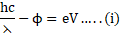
Step 2: For the first case with wavelength $\lambda$, the stopping potential is given by: $eV = \frac{hc}{\lambda} - \phi$ where $\phi$ is the work function of the metal.
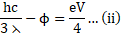
Step 3: For the second case with wavelength $3\lambda$, the stopping potential is: $eV' = \frac{hc}{3\lambda} - \phi$
Step 4: The stopping potential $V'$ can be expressed in relation to $V$: $V' = \frac{V}{3} + \frac{\phi}{e} - \frac{\phi}{e} = \frac{V}{3}$ (rearranging to find the new stopping potential).
Step 5: Given that the stopping potential for radiation of wavelength $3\lambda$ is $\frac{V}{4}$, we can set up the following equation: $\frac{V}{3} = \frac{V}{4} + \frac{\phi}{e}$
Step 6: Solve for $\phi$: Multiplying through by 12: $4V = 3V + 12\frac{\phi}{e}$
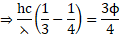
Solving gives: $\frac{\phi}{e} = \frac{V}{12}$
Step 7: The threshold wavelength $\lambda_0$ satisfies: $\phi = \frac{hc}{\lambda_0}$.
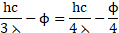
From the above, we can substitute: $\frac{hc}{\lambda_0} = \frac{V}{12}$.
This implies: $\lambda_0 = \frac{12hc}{V}$.
Substituting back in terms of $n \lambda$: Using the stopping potential we can express: $\lambda_0 = n \lambda$, leading to $n = 12$.
Therefore, the value of n will be: 12.
Step 2: For the first case with wavelength $\lambda$, the stopping potential is given by: $eV = \frac{hc}{\lambda} - \phi$ where $\phi$ is the work function of the metal.
Step 3: For the second case with wavelength $3\lambda$, the stopping potential is: $eV' = \frac{hc}{3\lambda} - \phi$
Step 4: The stopping potential $V'$ can be expressed in relation to $V$: $V' = \frac{V}{3} + \frac{\phi}{e} - \frac{\phi}{e} = \frac{V}{3}$ (rearranging to find the new stopping potential).
Step 5: Given that the stopping potential for radiation of wavelength $3\lambda$ is $\frac{V}{4}$, we can set up the following equation: $\frac{V}{3} = \frac{V}{4} + \frac{\phi}{e}$
Step 6: Solve for $\phi$: Multiplying through by 12: $4V = 3V + 12\frac{\phi}{e}$
Solving gives: $\frac{\phi}{e} = \frac{V}{12}$
Step 7: The threshold wavelength $\lambda_0$ satisfies: $\phi = \frac{hc}{\lambda_0}$.
From the above, we can substitute: $\frac{hc}{\lambda_0} = \frac{V}{12}$.
This implies: $\lambda_0 = \frac{12hc}{V}$.
Substituting back in terms of $n \lambda$: Using the stopping potential we can express: $\lambda_0 = n \lambda$, leading to $n = 12$.
Therefore, the value of n will be: 12.
Prepare Smarter with CGP Edu
Get practice questions, solutions, and test series in one place.
Write a Review
Share your experience with this question and solution.
Commentary
Send your comment, doubt, correction, or feedback to admin.
Similar Questions
Explore conceptually related problems
When the wavelength of the radiation falling on a metal is changed from 500nm to 200 nm, the maximu…
Given figure shows few data points in a photo electric effect experiment for a certain metal. The m…
In a photoelectric effect experiment, the graph of stopping potential V versus reciprocal of wavele…
When photon of energy 4.0eV strikes the surface of a metal , the ejected photoelectrons have maxim…
Radiation, with wavelength falls on a metal surface to produce photoelectrons. The electrons are m…
A metal surface is illuminated by a radiation of wavelength 4500 . The ejected photo-electron ente…